

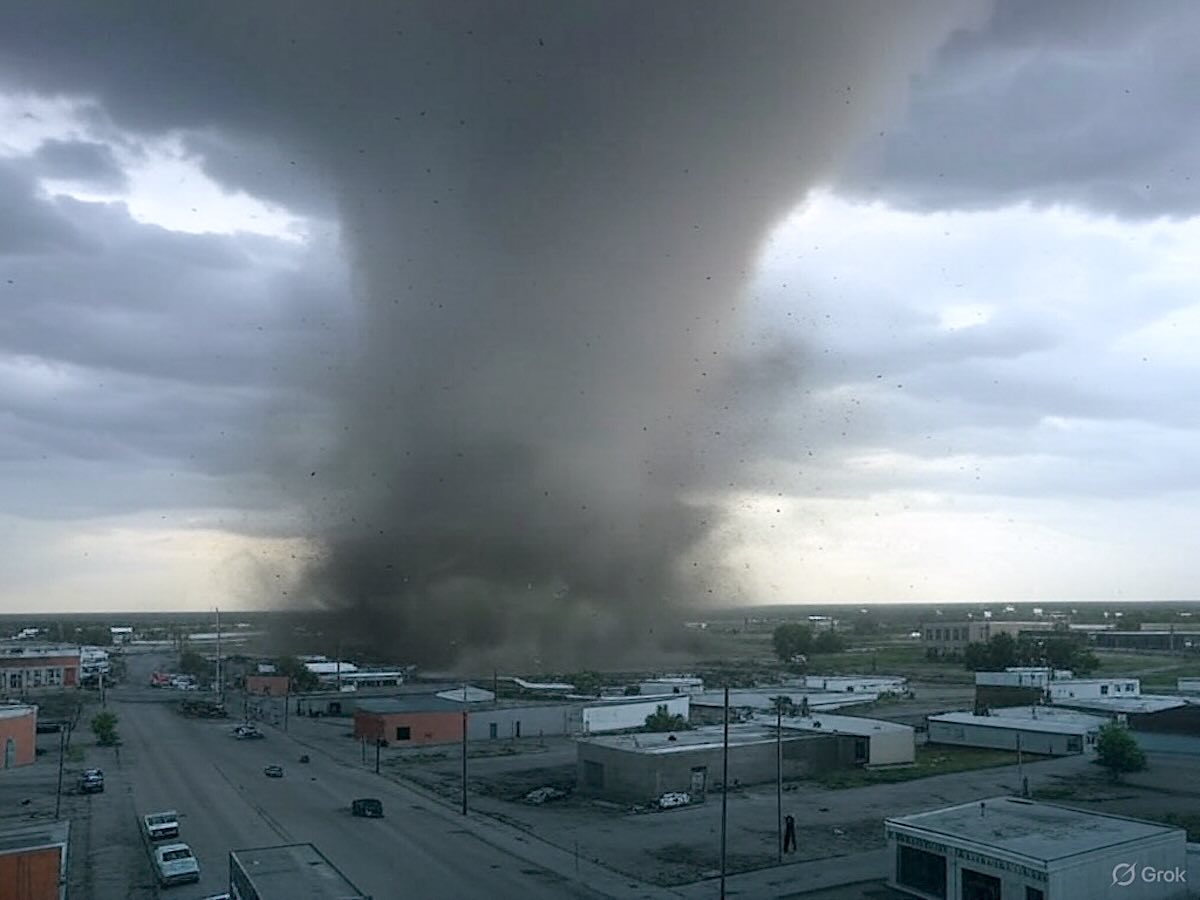
Through yesterday, according to preliminary data from the National Oceanic and Atmospheric Administration (NOAA) Storm Prediction Center (SPC), the U.S. has experienced 365 tornadoes, just four above the longer-term average to date. Last year, more than 1,900 tornadoes were observed, the most since 2011, and well above the longer-term average. [some emphasis, links added]
Today, I share the latest data on normalized U.S. tornado losses since 1954 and a time series of the incidence of the strongest tornadoes since 1975. I doubt you’ll come across this data anywhere else.
Comparing tornado losses across decades is not straightforward.
A tornado striking what was a rural county 70 years ago would cause far less damage than the same tornado striking that same heavily developed county today — because there is now more property and wealth exposed to loss.
To make meaningful historical comparisons of loss estimates, researchers “normalize” losses: they ask what each historical storm or event would cost if it occurred under today’s societal conditions, adjusting for factors such as inflation, wealth, building types and counts, population, and, in some cases, efforts to improve building quality.
This approach was first applied systematically to tornadoes by Simmons, Sutter & Pielke Jr. (2013), who analyzed NOAA SPC data from 1950 through 2011. Zhang et al. (2023) reproduced and extended the Simmons series through 2018, confirming the earlier results and updating the time series.
They concluded: “[O]ur results suggest a downward trend in tornado losses for the U.S. as a nation.”
The figure below shows my replication of the Zhang et al. tornado normalization from primary data and extends it through 2025. The normalized losses are expressed in 2026 dollars.

The dominant loss years are 1954 ($36 billion),1965 ($44 billion), and 1974 ($29 billion). The largest recent loss year is 2011 at $16 billion — the largest post-1980 value and the only recent year approaching the scale of the 1960s–1970s peaks. Since 2012, annual normalized losses have largely remained below $5 billion.
The time series shows a significant decrease in annual normalized losses. The 1954–1963 decade averaged $4.8 billion per year; the 2015–2025 decade averaged $1.9 billion per year.
Our 2013 paper identified this trend:
“We can definitively state that there is no evidence of increasing normalized tornado damage or incidence on climatic time scales.”
At the time, we hypothesized that the decrease may be due to an actual reduction in severe tornado incidence.
However, because economic data should not be used to infer trends in related climate variables, we suggested that any such trend in tornadoes would depend upon analyses of climate data.
More than a decade later, tornado data is strongly suggestive of an overall decline in the incidence of the strongest tornadoes.
The figure below shows the annual count of F3/EF3 and stronger tornadoes from 1975 through 2024, the period with the most consistent data quality.

The time series shows a clear decrease in major tornado incidence. The 1975–1984 decade averaged 49 F/EF3+ tornadoes per year; the 2015–2024 decade averaged 26 per year — a decline of roughly 46 percent.
Note that data available back to 1954 makes this decrease look much larger, but it is accompanied by questions of data quality.
The interpretation of this declining trend requires caution for several reasons. First, the Enhanced Fujita (EF) scale, introduced in 2007, changed rating methodology, creating a potential discontinuity in the series.
Most analysts believe EF ratings are somewhat more conservative than legacy F ratings for comparable damage, which could contribute to the apparent post-2007 decline.
Second, improved public warnings and storm-resistant construction may have contributed to changing the nature of observable damage markers that drive intensity ratings, which are often established based on damage patterns rather than direct measurements of tornado intensity.
Neither of these caveats undermines the fact that there is no evidence of an increase in violent tornado incidence over the observational record.
The IPCC Sixth Assessment Report concluded with low confidence in the detection of any trend in tornado frequency or intensity at the global or regional level, and with low confidence in attribution of any observed changes to anthropogenic forcing.
The data reviewed here are consistent with that assessment.
The Honest Broker is written by climate expert Roger Pielke Jr and is reader-supported. If you value what you have read here, please consider subscribing and supporting the work that goes into it.
Read rest at The Honest Broker

