
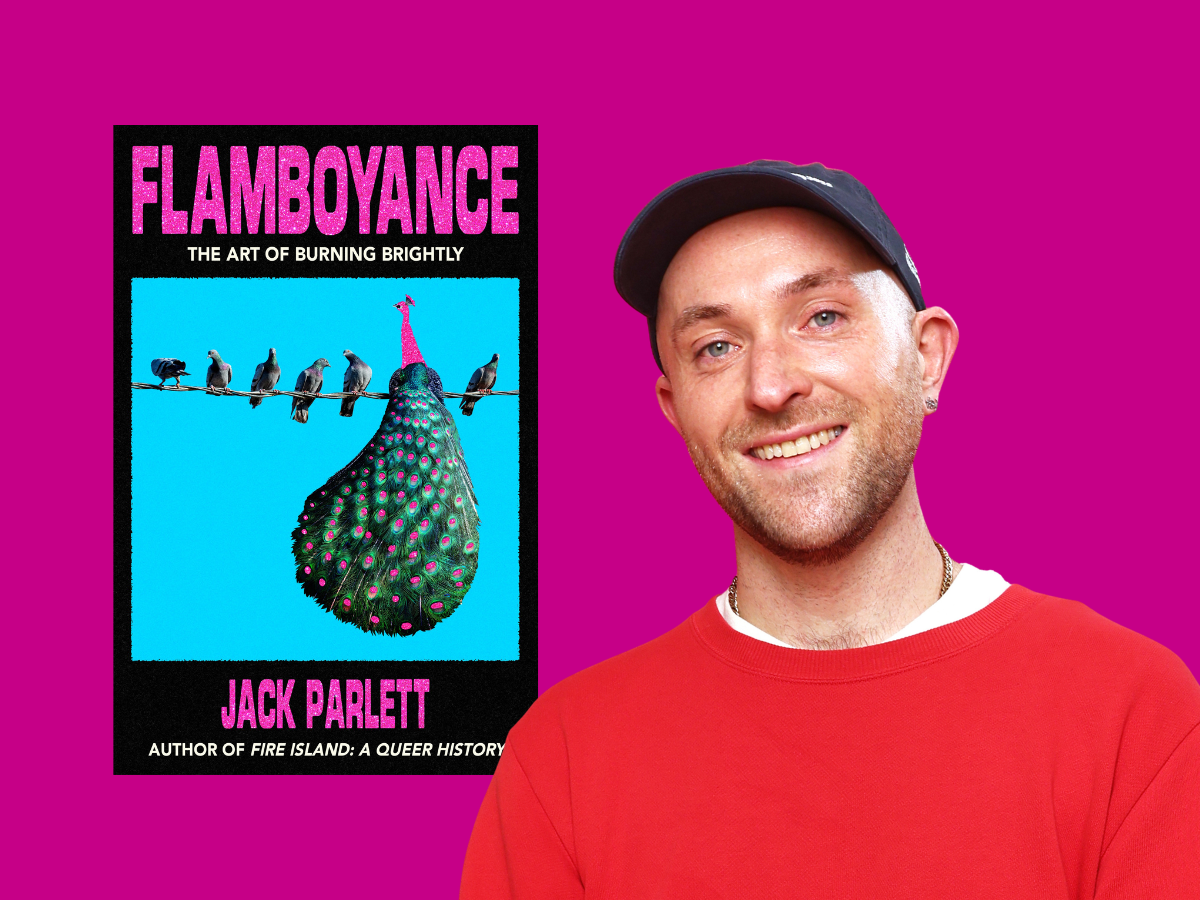
Flamboyance is something we all likely think we have a clear grasp on, but I’ll bet that when asked to actually put it into words, you, like me, would struggle. From the term’s first use in English in the relatively modern 1830s, originating from the flame-like architecture of Gothic European churches, to the lived practice of it, whether consciously or not, in both queer and straight culture, Jack Parlett’s Flamboyance: The Art Of Burning Brightly is part historical examination, part personal exploration, and part guide to living the life “of someone who knows exactly who they are.”
Parlett’s opening chapter title, ‘The Secret’, refers to both that hard-to-pin-down and equally hard to harness, for some, nature of flamboyance, as well as the author’s efforts in adolescence to hide the truth of his queer identity. His searing self-reflective honesty, especially about still being on a journey of self-acceptance, settles you into Flamboyance as less rigorous academia and more of a down-the-rabbit-hole adventure that you, the reader, are taking with Parlett – like a Doctor Who companion being led by the hand to an alien, but fabulous, planet.
Whether talking about Proust or David Beckham, the depth of his research is imaginatively scattershot and wonderfully evocative in its analysis, adorned with the personal insight of a well-travelled explorer who is still excited to learn more.
The two throughlines of the book that struck me were the fire/light metaphor inherent, across time and space, to every mode of flamboyance, and the constant tension between the outsider’s perception of flamboyance as artificial or performative and the insider’s use of it as the exact opposite: performative, yes, but in an effort to be as real as possible. The latter is only more fascinating in our current heightened age of digitally-enhanced artificiality, where authenticity feels more and more like a precious and endangered resource.
The former, meanwhile, is a striking way to paradoxically contain an elusive idea and keep it tied to its original meaning without dimming its fluidity, potency, or danger. “Flamboyance may be a kind of armour,” Parlett notes, “but it is not always protective.” To this day, living one’s ‘truth’ as brightly as possible still attracts both celebration and derision, sometimes from one’s own community, adding to the lively essentialism dancing across the pages of this work.
So, what is flamboyance? It’s perhaps Parlett’s summation of the genius of Abba that will stay with me if I’m searching for the words: “joy shadowed by melancholy, [a] combination of euphoria and yearning…” Or, for something visual, this recent video of Mariah Carey requiring an entire team of people to help her simply sit down. Queen shit.

