
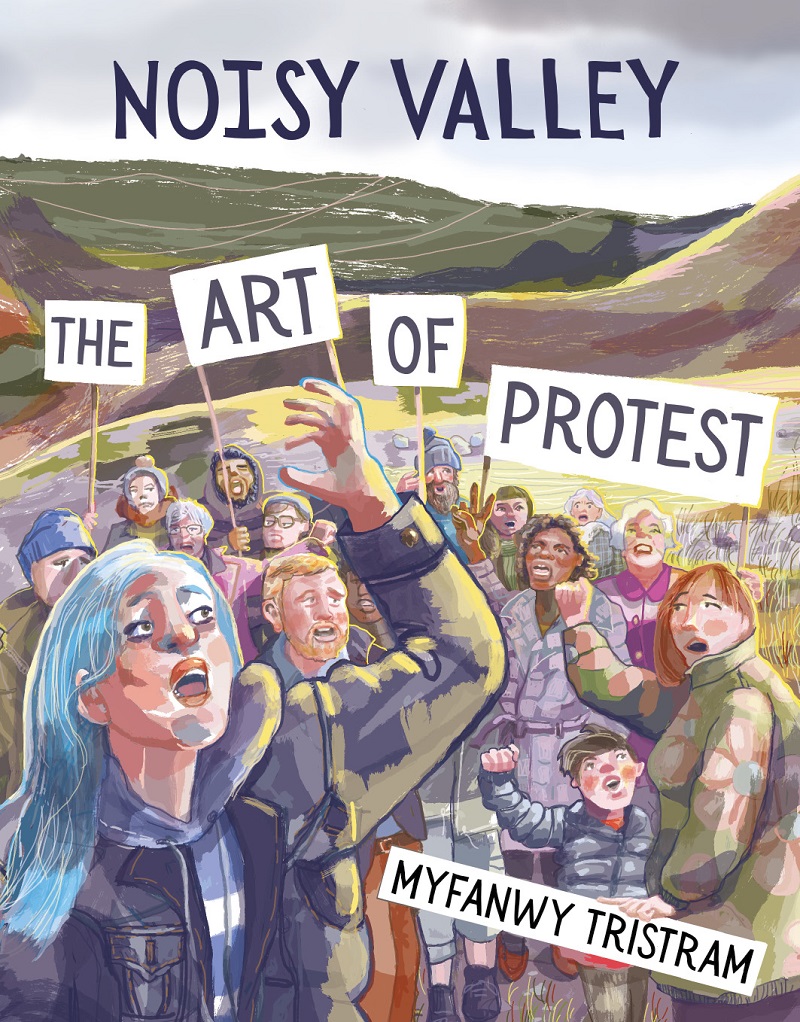
Myfanwy Tristram’s recently published book Noisy Valley is an illustrated account of her time spent talking to people in the Rhondda about their history of and experience with protesting against the powers that be. Ben Woolhead spoke to her about it.
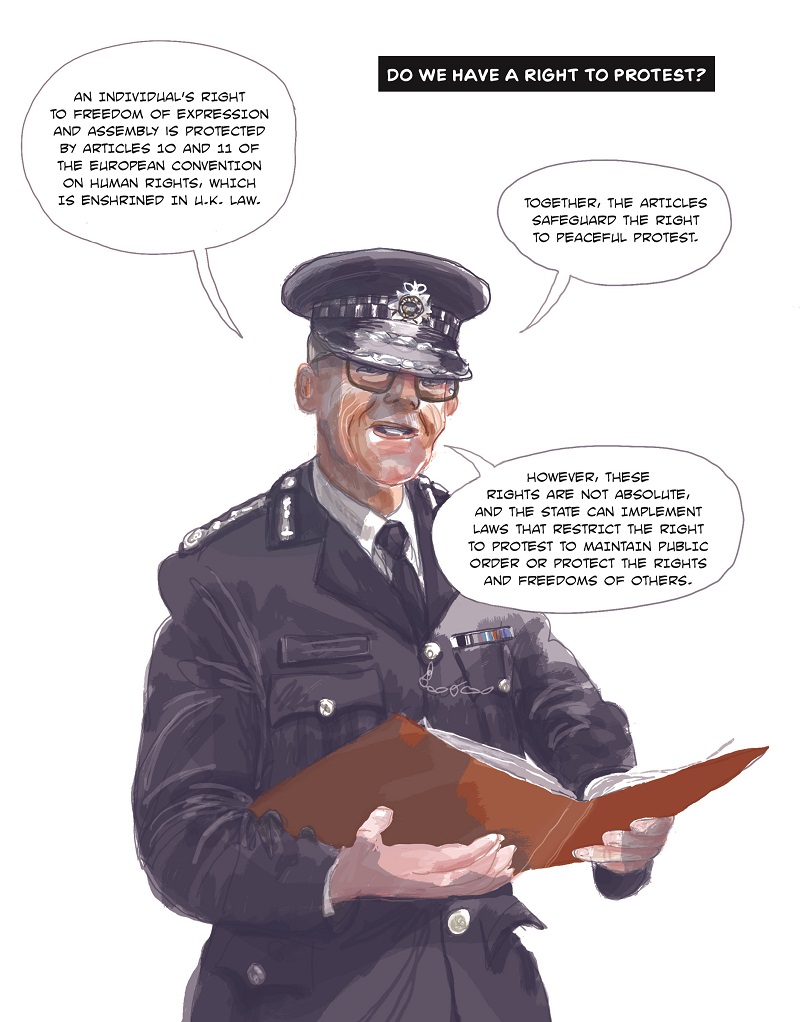
Noisy Valley is a “documentary comic” (to use author Myfanwy Tristram’s term) that taps into the Rhondda’s proud and rich tradition of dissent. It tells the stories of a host of local people with personal experience of standing up (or sitting down) and speaking out against everything from nuclear weapons at Aldermaston and Greenham Common to pit and hospital closures, environmental destruction and toxic landfill sites closer to home. A celebration of people power’s capacity to bring about change (and to create community and forge connections even when it doesn’t), the book is a robust defence of the right to peaceful protest – and a reminder of the restrictions that have been insidiously imposed on that right in recent years.
The seeds for Noisy Valley were sown in 2022, when you were invited to exhibit your work at the Workers Gallery in Ynyshir. What were your first thoughts when the invitation came through?
My first thought was that I was very pleased indeed. I’d never had a solo exhibition before, so it was a thrill to be asked. And then my second thought was that the pictures they’d asked me to exhibit – images of protesters – had originally been drawn for Instagram, so they were quite small! I was worried they might not blow up to a decent size for an actual gallery wall. But it was OK – we got them to an A4 size without losing too much sharpness.
You initially intended to make a zine, but then it blossomed into a much bigger project. How did it develop, and how did the deal with publisher SelfMadeHero come about?
Yes – I travelled down to see the exhibition and I thought that while I was there, it’d be nice to use my time productively. I planned to ask local folk to share their memories of protest, and then I’d draw them up. I remember thinking I wanted it to be a quick project, so I’d do it in the zine aesthetic – quick, loose and scribbly.
But then once I actually heard the stories, I realised I needed to give them the time and attention they deserved – they were too rich and meaningful to draw sloppily. So I put aside the project I’d been working on (a graphic memoir of my teen years as a goth) and dedicated proper time to this. But still at this point I thought I’d be self-publishing, which is really common in comics, and is what I’d done with most of my work before this.
There’s a competition called the First Graphic Novel Award, and when the opening date rolled around, I thought I might as well submit what I had so far – just for affirmation as much as anything else. The first prize is a publishing deal with SelfMadeHero and I didn’t win, but I was shortlisted. That’s when I was approached by my agent Corinne Pearlman, and it was she who sent the book around – eventually, as it happened, placing it with SelfMadeHero.
I’d assumed that, as I hadn’t won, that door was closed, but it turned out not to be the case, and I was really pleased to have an offer from one of the UK’s few dedicated graphic novel publishers. They’ve published some of my favourite books over the years, as well.
How many stories did you have to leave out? How did you decide which ones to include?
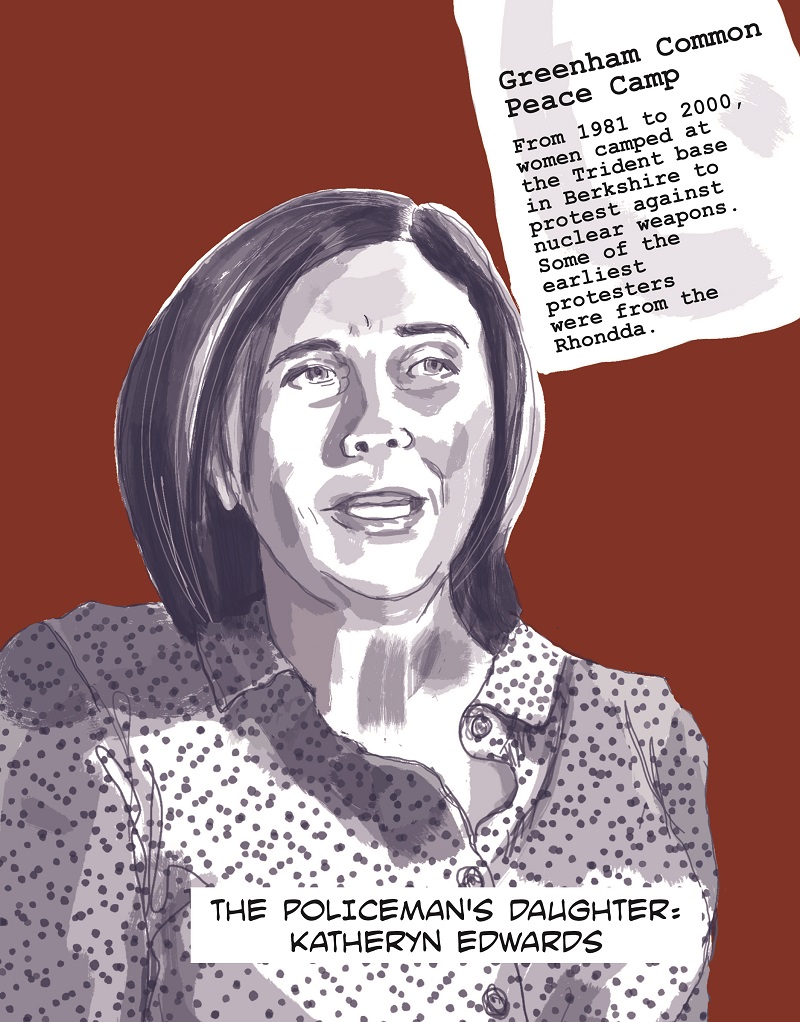
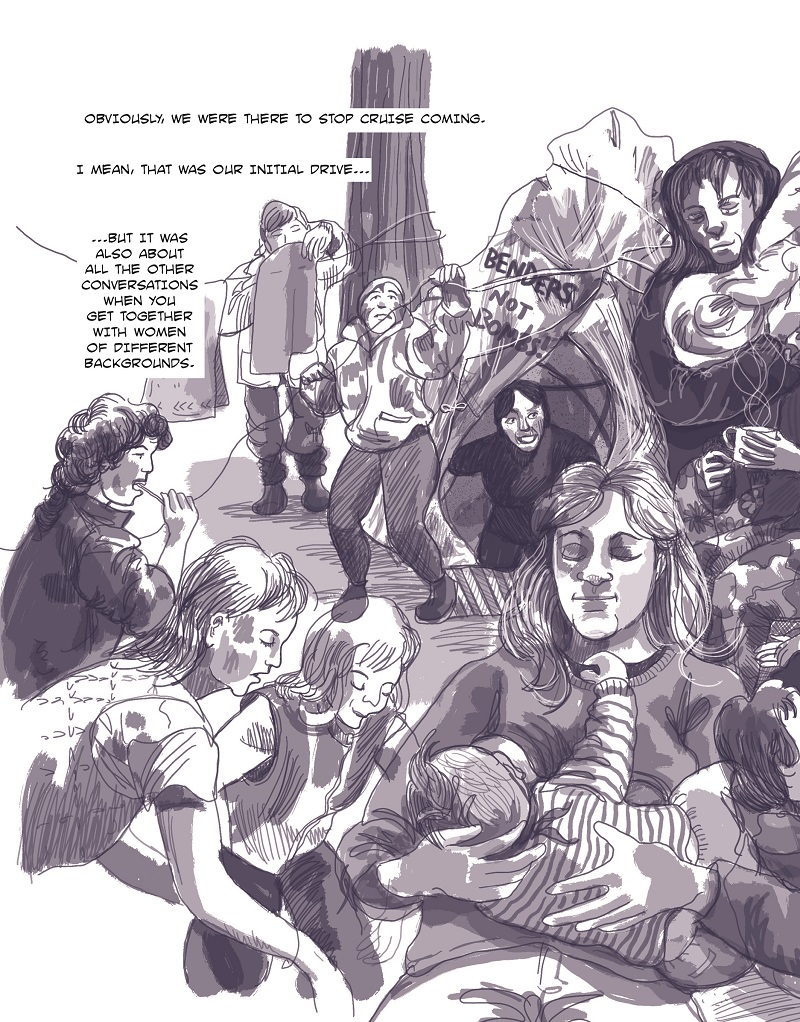
I think it might have been three or four that didn’t make the cut in the end, and that wasn’t because they weren’t good stories. Gayle Rogers from the Workers suggested that we keep the project as local as possible, and that was a good instinct. That’s not to say all the stories happened in the Rhondda (for example, there’s one about Greenham Common and another about the Aldermaston marches), but their storytellers all live in the region.
It’s given the book some coherence, a sense of place. People told me that it’s not just the history of the Rhondda that has shaped the people (though with it being such a militant holdout during the miners’ strike, of course, that is a huge factor), but the geography as well. When you’re surrounded by those steep mountains, communities become tighter, more contained. I heard that accents change markedly between valleys that are only a couple of miles from one another as the crow flies, because actually moving from one to the other involves either a very steep climb or taking the long way round by road!
In the book, you defend the right to protest on general principle, and one of the featured people, Tracey Leonard, talks about feeling a sense of duty as a protest photographer to cover all protests, whether she believes in the cause or not. Would you have included stories about causes you don’t believe in or are even opposed to?
That’s a very astute question. Obviously, in recent years, we’ve seen protests that I don’t feel very comfortable with, but which could certainly be described as people rising up and exercising their right to be heard – like the storming of the US capitol or, closer to home, extreme-right rallies. There are also protests based on complete misinformation, like those against the 15-minute city.
You can draw a moral line. On the one hand, there are protests that cause injury and even deaths, plus those that are based on lies and intended to create societal disharmony. On the other, we might see non-violent direct action, where instigators are keen to make their fact-based point as strongly as possible, without ever tipping over into violence.
As for the stories I heard for Noisy Valley, it’s true that, not being from the area, I wouldn’t necessarily have both sides of every story – though it seems pretty clear cut that, for example, where industry is causing pollution that raises the rate of birth defects in the area, it’s reasonable to push back. Most of the protests depicted in the book show people valuing the things that make life precious – nature, health, security, equality – over the interests of big business or the state.
The only one that might not be seen as entirely black and white is the Northern Meadows protest, which saw protesters trying to protect a piece of ancient meadowland, and all the birds, animals and flowers that flourished there. But the planned development was for a cancer hospital. At first hearing, you think this might be a difficult one. But then you hear the arguments about why that’s not an ideal place for that particular facility, and the corporate interests behind it. Ultimately, though, it’s not really my place to judge. I’ve told the story of people who believed passionately that the hospital should have been built elsewhere, and acted on it. That’s good enough for me – just to depict an act of non-violent protest that comes from a deeply held conviction.
And, as with the story of the Nantygwyddon tip, as the story progresses, you learn that the “small” people in the community are being intimidated by all the levers of the law, from massive, unpayable fines to injunctions that prevent you from talking in public about the issue – and even imprisonment. It feels important to depict that.
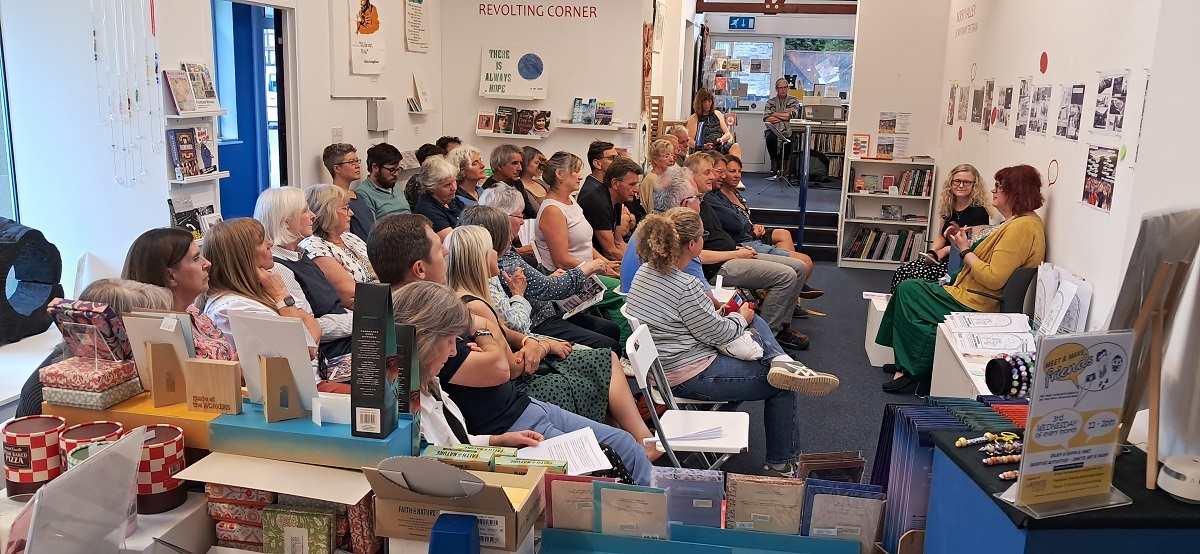
How was the experience of launching the book at the Hay Festival and at the Workers? What has the response been like?
It’s been amazing. The two events were quite different, as you might expect. It was my first visit to Hay, and I was so impressed by how well it’s run. As a speaker, they really make you feel like a VIP! We had a great, totally engaged audience, and then a signing afterwards. I believe we sold out of Noisy Valley – everyone there was a book lover and they’d all come ready to buy books, which is of course very gratifying for an author.
A couple of days later, I was down at the Workers, where to be honest, the event was a lot more emotional. We’d invited some of the people featured in the book to stand up and speak, and that was so moving. Not only were they talking about the importance of protest, and how their own experiences had shaped their lives and had an effect on local history, but also about how glad they were to have had these stories carried beyond the Rhondda and into the wider world.
Absolutely everyone featured in the book has been so generous, not just sharing their time and their memories, but giving me the licence to represent them and trusting me to tell stories that are, in most cases, very personal. The Workers has been amazing too, supporting me throughout – without them, the book would clearly never have happened.
As you point out in the book, the right to protest has been eroded in recent years – what can we do to protect what we have left?
What I really hope Noisy Valley will do is to reshape the concept of protest away from the current media and government narrative where it’s painted as something sinister, unwelcome, even illegal, and remind us of all the positives. Protest is a creative act and a way of making community. It’s somewhere where people sing, dance, stitch and paint beautiful banners. And protest is also a vital part of a functioning democracy – without it, we have no lever to push back when we don’t like the moves our governments are making.
So, within the current laws of the land and the way that our democracy operates, we can write to our political representatives to tell them how and why we have protested in the past, and why it’s vital that we be able to in the future. Write To Them is an easy way to do that. Personal stories always have power.
And it’s important to say that it’s not illegal to protest at all; the new laws restrict things like the time and location of marches, and give police more powers of arrest. So, if you feel strongly about an issue, my advice is to make sure you know precisely what is allowed, and act within the law. The website of the human rights charity Liberty is a good place to find up-to-date guidelines.
You’ve previously mentioned that the experience of creating Noisy Valley has changed the way you work specifically, and indeed your whole life – in what ways? What do you feel you’ve learned about yourself and your artistic practice?
It’s the format of the book that really changed the way I work. This was the first longform graphic novel I’d made that was based on interviews with real people, not changing their words, and just depicting their memories as faithfully as I could. I’ve learned so much – but I think the most important learning is that once you start inquiring into a topic, or a neighbourhood, whatever or wherever it may be, you will find fascinating stories that need to be told. My only issue now is that life is short and there are so many more to discover and draw!
What causes inspire you to protest?
There’s so much to rail against at the moment, isn’t there? As a creative artist, the rise of generative AI, which sucks up our work with no recognition or recompense, while also taking away so many job opportunities and also destroying the environment, has to be pretty high up there.
But generally, it’s wherever there is injustice. If I can’t join a march, I might email my MP. Or if I have the time available, I might draw a comic! Marches are fantastic for showing strength in numbers, but only for a single day. At least a comic or graphic novel can go out into the world – into shops, libraries and people’s homes – and continue to share its message for years to come.
Noisy Valley is published via SelfMadeHero. Info: here
The Noisy Valley exhibition is at the Workers Gallery, Ynyshir until Sat 15 Aug. Info: here
words BEN WOOLHEAD

