
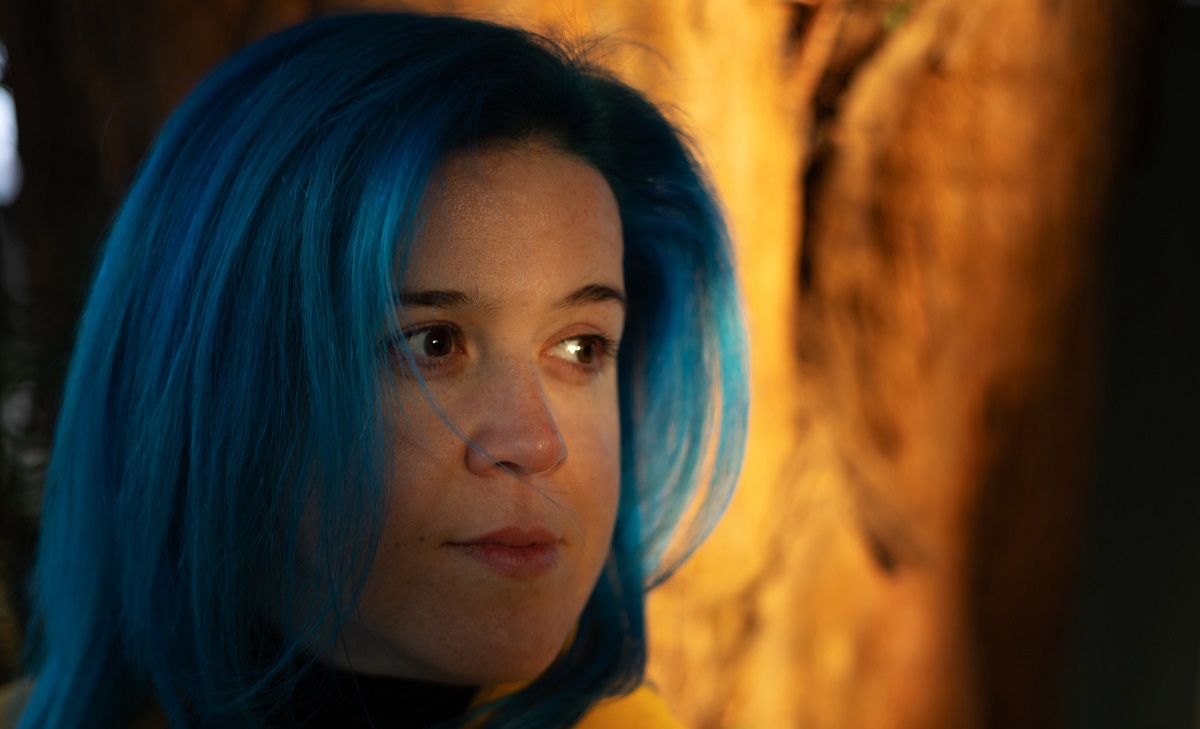
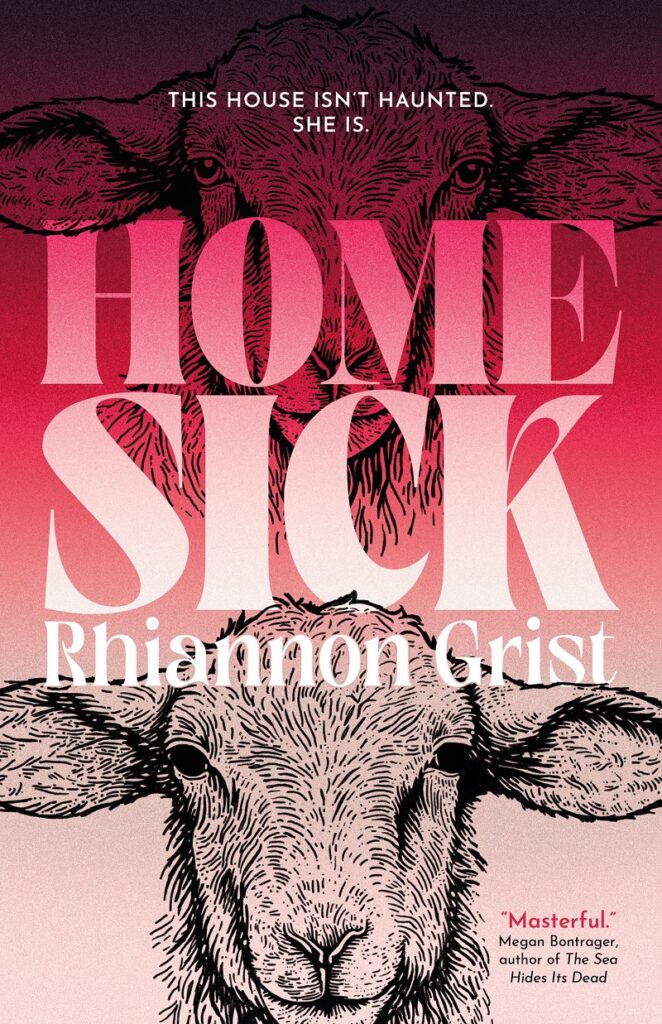
Following 2023 novella The Queen Of The High Fields, set in her home nation of Wales, Rhiannon Grist returns with Home Sick – a psych-horror novel set in the wilds of her current home, Scotland. Keren Williams asked her some questions about it.
Where did the first idea for this novel come from, and at what point did you realise it was going to become a full-length story?
Home Sick started as a bad joke. My writers’ group was at the pub coming up with horror stories for the socially anxious, and that’s when I came up with the core idea: you move to a cottage in the middle of nowhere, only to arrive and find it’s a semi-detached with a complete stranger living in the other half.
I didn’t really start working on it until after I moved home in 2021. It was a newbuild and we were still in successive lockdowns, so I wasn’t able to look inside until I moved in. I had such a rough time settling into the new place. Everything felt wrong. And as the months wore on and folk asked how I was getting on, I found myself lying more and more often. Eventually I started writing down the truth of how I was feeling into that bad joke idea.
I think it was when I had about 10,000 words I realised – this could be a book! I’d originally meant it to be about a family, but the focus shrank down to this one woman and her internal world. It became this claustrophobic, nasty dive into a fractured self that was also dealing with something that may or may not be human next door.
What is it about the weird and the dark that keeps drawing you back as a writer?
The universe is a strange and often frightening place. We still don’t fully understand how gravity works. Light is simultaneously a wave and a particle. There are so many things I’m going to die not understanding about our world. Weird fiction leaves room for the possibility that there are no good or easy to understand answers.
I have a soft spot for stories about people who go through something strange with little understanding of what exactly just happened to them. Books like Kathe Koja’s The Cipher, Adam Nevill’s The Ritual, Lucy McKnight Hardy’s Water Shall Refuse Them. What’s important is what it means to the character, the stakes and the consequences of their actions. What do the mysteries of life mean to us and how do we find direction in our darkest moments?
As a Welsh author, in what ways has Wales influenced your writing?
I’m hesitant to generalise about any nation or culture – I don’t like saying things like “storytelling’s in the blood of [insert nationality here]” – but the arts were very culturally important to Wales when I was growing up in the 90s and 00s. I’d compete in the Eisteddfod each year at school, I was a member of multiple drama groups, and choirs were big across my childhood. Both my grandmother and my father were active members of am drama groups and wrote poetry in birthday cards.
Art wasn’t just a special pursuit for those who could afford it. It was an integral part of the community. Pantos, choirs, comedy skits at your work Christmas party. Even today, my dad still performs in an Oasis cover band that’s been doing the rounds of pubs in south Wales.
That access to the arts growing up has had a massive impact on my writing. I was exposed to Dylan Thomas in my early teens, Monty Python sketches and The Goon Show even younger than that, and Welsh folk songs from day dot. I grew up hearing what could be done with words.
You won the British Fantasy Award for Best Novella in 2023. How different was the experience of writing your debut novel, and did anything about the process surprise you?
I actually wrote my first novel-length work when I was 13. In school, I was that smart, slightly odd kid who couldn’t quite gel with other children their age, so I spent a lot of time inside my head. Eventually one of my daydreams got so big I was scared of forgetting it, so I started writing it down. I wrote three books – none published of course, I hadn’t the first clue about that – before leaving school at 18, so I’ve been comfortable drafting novel-sized work for a while now.
I wrote another book in my twenties but again had no idea how to edit it, let alone where to send it. Then I finally took the advice of multiple writers and joined a crit group and started working on short fiction. I’d stupidly resisted this for a long time, and discovered fairly quickly that, yes, you can improve a lot when you focus on honing shorter pieces and get feedback from other writers.
I’d say the main difference between writing a novel and writing shorter pieces, at least for me, is bandwidth. With a novel there’s just more to hold in your head. When I’m deep in a novel, it’s like I’ve got one foot in this world and the other in the book. It can make you a bit absent-minded. In general, I’d say every book is different and surprising. Just when you think you’ve got your process sorted, the next story comes along and knocks you back to square one.
Were there any particular authors or books that influenced this novel, or that have shaped the kind of writer you’ve become?
I saw a student production of Sarah Kane’s 4.48 Psychosis at university which has stayed with me a long time. It’s honest and brutal and totally arresting. I liked Ottessa Moshfegh’s My Year Of Rest And Relaxation and Shirley Jackson’s The Haunting Of Hill House for similar reasons, so readers might see their influence in Home Sick as well.
The horror of Home Sick probably leans closer to Mark Z Danielewski’s House of Leaves, Andrew Michael Hurley’s The Loney and Arthur Machen’s The Great God Pan than, say, a slasher – though there are a good few gory moments later on. I love eerie, oppressive spaces where the environment is its own character.
When writing horror or unsettling scenes, how do you decide what to reveal and what to leave to the reader’s imagination?
I think most folk know the basics by now. Be picky with your details at first. Give just enough to outline the terrifying thing, but let the reader’s mind fill in the rest. If you describe it too much, it loses its mystique which is a big part of the fear. By the time a monster is revealed, writers and filmmakers generally rely on disgust to carry the horror onward. That’s when you want to use a lot of detail.
Something I’m specifically experimenting with right now is using segments of stillness. You know those moments in a horror movie where you’re searching the darkness on screen, looking for something wrong? I want to bring that tension to the page.
Without giving away spoilers, what was your favourite part of Home Sick to write?
My mind changes every time I’m asked this! There’s a moment about a third of the way through, where Tamsin does something a little unexpected. Something that sort of breaks the rules for that scene. When I was first writing that part of the book, I was concerned it was a little paint-by-numbers. I’d recently read some advice online that when your story is feeling a little stale, you should think of the worst weirdest thing that could happen.
So I did – and then I wrote the next few chapters like I’d stolen a car, fast and off the beaten track. The whole time I was worrying that I’d irrevocably ruined the book and that there was no way I could get the story back on track. Funnily enough, that one surprising action ended up tying together with Tamsin’s character and the rest of the story pretty nicely. So I guess the risk paid off.
Home Sick is published on Thurs 16 July via Solaris.
Price: £9.99. Info: here
words KEREN WILLIAMS

