
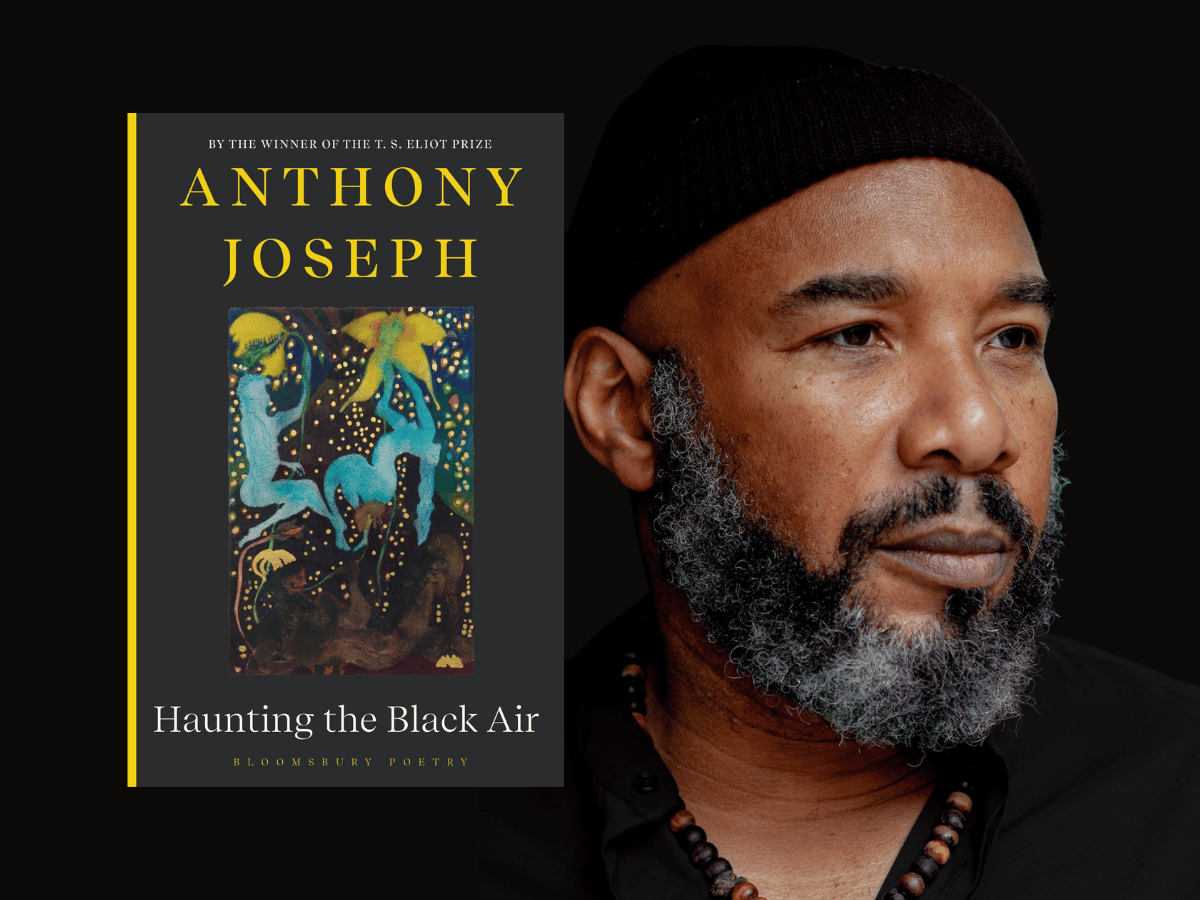
Anthony Joseph has lived in Britain since his early twenties, and for nearly 40 years, but his Trinidadian upbringing remains endemic to his creative output. In Haunting The Black Air, Joseph’s sixth volume of poetry, the island casts a shadow that belies its size. We catch up with him in several other places, too – maybe three further continents – in the shifting form of several dozen poems with a breadth as wide as the poet’s horizons.
Joseph has gone back and forth between verse and prose since debuting in the 1990s. Sonnets For Albert, which per its title concentrates on a single style, won the T.S. Eliot Prize after its publication in 2022. For my part, I came to him via the earlier Kitch – an inspired speculative biography of calypso singer Lord Kitchener, one of Trinidad’s most iconic sons and Windrush émigré in 1948. I have no idea if the bit where Kitch and Shirley Bassey get pissed up in a Manchester front room has any basis in actual events, but it certainly delighted me as fanfic.
Also a spoken-word vocalist on a number of albums backed by musicians like Shabaka Hutchings, Joseph is at his most luminous when he writes about or alludes to the sounds which make him tick. In ‘New York Soul’ he goes clubbing in Manhattan and talks with loving admiration of a pal’s dance moves. James Brown and Charles Mingus are invoked during ‘Combustible’, Albert Ayler on ‘Swing As Praxis’; a Bukka White song serves as simile in ‘Cameo’. In ‘The Kimberley Hotel’, he’s up past bedtime in Cape Town being a huge nerd about the Fela Kuti discography. Even if you’re unlikely to find yourself in a remotely similar scenario, it’s tastily evocative stuff.
Haunting… also has much to say about family distant and immediate, the perpetual reverberations of colonialism, religious ceremony and the visceral reality of death. It tangibly experiments with language and syntax more often than not, with a few poems arranging themselves in visually challenging ways on the page and Joseph using a repeated ident where, for no obvious reason, he switches out a lower-case f for a capital C in words. If, consequently, those words are merely intriguing, most of the others in this collection are exceedingly impactful, and never superfluous.

