Somewhere in Man/Woman/Chainsaw’s cloying debut album lies a band unafraid to go large, and capable of grand emotional impact.
The post MAN/WOMAN/CHAINSAW: so/so/theatrical/indie/debut/album appeared first on Buzz Magazine.


Somewhere in Man/Woman/Chainsaw’s cloying debut album lies a band unafraid to go large, and capable of grand emotional impact.
The post MAN/WOMAN/CHAINSAW: so/so/theatrical/indie/debut/album appeared first on Buzz Magazine.

Hill and Jean were speaking ahead of Diaspora Calling! By Ms. Lauryn Hill, a one-day festival that will make its UK debut at the Milton Keynes National Bowl on Friday.
The event will feature performances from Hill, Jean, Erykah Badu, Giggs, Fireboy DML, YG Marley and Zion Marley, with comedian Dave Chappelle hosting.
Reflecting on the anniversary of The Score, Jean said the Fugees’ ambitions had always extended beyond music.
“I remember saying from a very young age, we’re not going to do music, we’re going to be a movement,” he said.
He said the themes explored by the group three decades ago remain as relevant as ever.
“When you talk about the idea of refugees, look where we are today. We were saying these things 30 years ago. It was never just about us – it was always about the movement.”
Hill said the Fugees themselves embodied the idea behind Diaspora Calling.
“Our different places of origin came together to unite culture, reflect culture and show people how beautiful, powerful and resourceful that culture is,” she said.
Earlier in the day, Hill and Jean surprised fans with a pop-up appearance in London’s Piccadilly Circus, performing an a cappella rendition of Ready or Not.
Hill said London was the natural place to launch the festival.
“There’s so much of the diaspora in London,” she said. “So many people are represented here. It felt like a full-circle moment for us.”

Sydney Towle, a popular social media influencer who shared her experience living with a rare, aggressive form of cancer, has died at the age of 26.
Towle’s family announced her death, from complications related to bile duct cancer that had spread to other parts of her body, on her social media accounts on Thursday.
“Syd went peacefully last night after an almost three-year-long battle with cholangiocarcinoma,” her brother Austin said in a video message, alongside their mother, on TikTok.
Towle, who was moved to hospice care earlier this week, had over a million followers on TikTok and over 200,000 on Instagram.
She spent the last three years chronicling her daily life as a young person going through chemotherapy and living with cancer, with all its hopes, joys and struggles. She had been living in New York City at the time of her death.
“We are so proud of how hard Sydney fought and for sharing her journey with so many people,” Towle’s family said in a statement.
“She wanted to raise awareness for rare cancers and was passionate about promoting self-advocacy. We will continue her legacy and honour her in every way we can.”
Following the announcement of her death, thousands of followers posted messages on Towle’s social media accounts paying tribute to her and sending well wishes to her family.
“Sweet angel. Fly high,” actress Alyssa Milano commented. “Praying for all who loved her. She is really something special.”
“You were such a bright light and will be missed,” one person wrote on Instagram, while another said: “How lucky we all are to have found you on the internet. Thank you for sharing yourself and your story.”
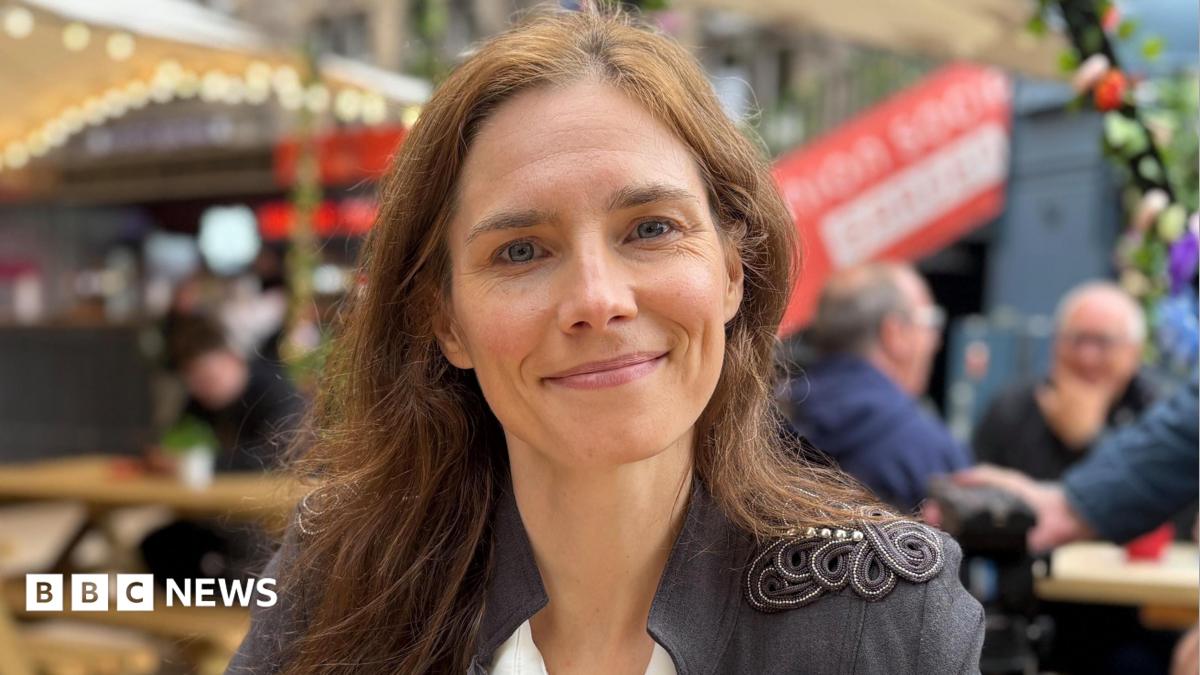
Amanda Knox, who was convicted and later acquitted of murdering British student Meredith Kercher in Italy in 2007, has defended her solo comedy show following calls for it to be cancelled.
The sold-out show called Cartwheel, which Knox will perform at the Edinburgh Festival Fringe, discusses motherhood and how she will explain the case to her daughter.
Knox told the BBC she is not the first person to use comedy to talk about traumatic events and said her material focuses on “how the world is unsafe and unfair towards women”.
But Stephanie Kercher, the victim’s sister, said she is concerned it will “normalise and trivialise” violence against women, and Meredith, in particular.
Speaking on BBC Breakfast, Stephanie Kercher, said: “What I would say [to Knox] is to think about the family here, think about her friends and to turn the tables if it was your sister that this had happened to, because I know you have a sister as well.”
Responding to the comments, Knox said: “The interesting irony of that is that my daughter is a huge motivation for me doing this show.
“It’s about how the world is unsafe and unfair towards women and what it means to raise a daughter in that world, knowing how bad it can be.
“If they [Kercher’s family] saw my show, they would recognise that.”
A petition against the show, set up by a friend of Meredith, has been signed by nearly 5,000 people.
It states the show disrespects her memory and risks making light of such a harrowing event.

Tide times for the week commencing Thursday, August 6:
Thursday, August 6: 00.17 (10.05m), 06.22 (2.55m), 12.45 (9.55m), 18.46 (2.90m)
Friday, August 7: 01.12 (9.42m), 07.19 (3.10m), 13.48 (9.05m), 19.52 (3.42m)
Saturday, August 8: 02.25 (8.90m), 08.32 (3.52m), 15.09 (8.81m), 21.18 (3.66m)
Sunday, August 9: 03.51 (8.78m), 10.03 (3.56m), 16.33 (9.08m), 22.52 (3.37m)
Monday, August 10: 05.11 (9.18m), 11.27 (3.12m), 17.44 (9.76m)
Tuesday, August 11: 00.07 (2.69m), 06.16 (9.88m), 12.31 (2.42m), 18.42 (10.58m)
Wednesday, August 12: 01.04 (1.92m), 07.08 (10.63m), 13.22 (1.72m), 19.31 (11.34m)

[noscript_1]
Scientists have used Artificial Intelligence to design new viruses capable of killing cells in the laboratory.
It marks the first time that the new technology has been used to successfully generate whole genomes, or the full set of genetic instructions needed to build a working organism.
Supporters of the work said it offered hope for developing new treatments, but critics quickly warned it raised ‘urgent’ safety and security concerns.
In their study, researchers at Stanford University, California, used the technology to create a genome for a virus that infects bacteria.
The AI suggested thousands of genomes, and the researchers created 302 in the lab before exposing them to bacteria.
Overall, 16 of the viruses suggested by the AI were able to kill E.coli.
The viruses they created were bacteriophages, which only infect bacteria and are not able to infect human, animal, or plant cells.
Revealing the results, Dr Brian Hie, a chemical engineer behind the research, said: ‘In this case, we wanted the model to generate the entire genome end-to-end in a single left-to-right pass. We didn’t add anything.’
Scientists have used AI to design a new virus that was capable of infecting other cells
The research was published alongside an accompanying article warning over the potential risks of the advance.
Written by Johns Hopkins experts Dr Thomas Inglesby and Dr Maurice Hanke, it warned: ‘Although this is promising for life sciences applications, it also raises urgent biosafety and biosecurity questions.
‘The ability to compose viral genomes using generative AI now exists; the governance to safely steer it does not.’
For the research, published in Science, scientists used the AI tools Evo1 and Evo2.
These work in a similar way to large language model chatbots ChatGPT and Grok, except they have been trained on genetic codes rather than written text.
Researchers trained the models on two million genomes for bacteriophages, and then tasked them to create new potential genomes.
Scientists synthesized the AI-made genomes in the lab and put them into petri dishes containing E.coli, prompting the bacteria to start making copies of the viruses.
Petri dishes were then monitored to establish whether the bacteriophages had started to attack and kill the bacteria.
Samuel King, a PhD student in the lab, told the BBC: ‘We were starting to see these clear spots and it was just extremely exciting.’
They wrote in the paper: ‘This work provides a blueprint for the design of diverse synthetic bacteriophages and useful biological systems at the genome scale.’
Scientists said bacteriophages have one of the smallest genomes known, making them much easier to create.
They said, however, that the work was a step towards AI being used for more advanced research.
Dr Patrick Cai, a researcher at the University of Manchester in the UK, said: ‘While these are relatively small bacteriophage genomes, the significance extends far beyond phages.
‘It suggests that genome language models are beginning to learn the design principles encoded by evolution, opening the door to AI-assisted genome writing.
[noscript_1]
Scientists have used Artificial Intelligence to design new viruses capable of killing cells in the laboratory.
It marks the first time that the new technology has been used to successfully generate whole genomes, or the full set of genetic instructions needed to build a working organism.
Supporters of the work said it offered hope for developing new treatments, but critics quickly warned it raised ‘urgent’ safety and security concerns.
In their study, researchers at Stanford University, California, used the technology to create a genome for a virus that infects bacteria.
The AI suggested thousands of genomes, and the researchers created 302 in the lab before exposing them to bacteria.
Overall, 16 of the viruses suggested by the AI were able to kill E.coli.
The viruses they created were bacteriophages, which only infect bacteria and are not able to infect human, animal, or plant cells.
Revealing the results, Dr Brian Hie, a chemical engineer behind the research, said: ‘In this case, we wanted the model to generate the entire genome end-to-end in a single left-to-right pass. We didn’t add anything.’
Scientists have used AI to design a new virus that was capable of infecting other cells
The research was published alongside an accompanying article warning over the potential risks of the advance.
Written by Johns Hopkins experts Dr Thomas Inglesby and Dr Maurice Hanke, it warned: ‘Although this is promising for life sciences applications, it also raises urgent biosafety and biosecurity questions.
‘The ability to compose viral genomes using generative AI now exists; the governance to safely steer it does not.’
For the research, published in Science, scientists used the AI tools Evo1 and Evo2.
These work in a similar way to large language model chatbots ChatGPT and Grok, except they have been trained on genetic codes rather than written text.
Researchers trained the models on two million genomes for bacteriophages, and then tasked them to create new potential genomes.
Scientists synthesized the AI-made genomes in the lab and put them into petri dishes containing E.coli, prompting the bacteria to start making copies of the viruses.
Petri dishes were then monitored to establish whether the bacteriophages had started to attack and kill the bacteria.
Samuel King, a PhD student in the lab, told the BBC: ‘We were starting to see these clear spots and it was just extremely exciting.’
They wrote in the paper: ‘This work provides a blueprint for the design of diverse synthetic bacteriophages and useful biological systems at the genome scale.’
Scientists said bacteriophages have one of the smallest genomes known, making them much easier to create.
They said, however, that the work was a step towards AI being used for more advanced research.
Dr Patrick Cai, a researcher at the University of Manchester in the UK, said: ‘While these are relatively small bacteriophage genomes, the significance extends far beyond phages.
‘It suggests that genome language models are beginning to learn the design principles encoded by evolution, opening the door to AI-assisted genome writing.

The ‘explosive’ parasite sickening thousands in the US may have spread to other fruits and vegetables, a former CDC director has warned.
Health officials have been scrambling to find a source of the cyclosporiasis outbreak after initially linking it to shredded lettuce sold at Taco Bell and other stores.
Now, Dr Robert Redfield, speaking in a TV interview, has warned that other commonly consumed US produce may also be carrying the parasite.
Speaking to NewsNation, he said: ‘They have pulled this suspected lettuce off the marketplace. We are seeing some outbreaks linked to parsley and cilantro, particularly in North Carolina.’
‘The only way you get cyclosporiasis is you have to eat vegetables… that were contaminated with human feces.
‘Lettuce is a big one [source of cyclosporiasis], cilantro, parsley, [but] we’ve seen it with blueberries, raspberries and snowpeas [too].’
He added: ‘Most of the times we’ve seen these outbreaks in the last ten years, they’ve come from imported produce.’
Redfield, who led the CDC from 2018 to 2021, urged people to eat locally grown produce, saying there was no current sign that local produce was contaminated.
Former CDC Director Dr Robert Redfield warns the cyclospora outbreak may not be contained to lettuce, as cases surpass 22,000 nationwide
Nationwide, more than 22,000 people across 47 states have been sickened with cyclosporiasis and 500 have been hospitalized so far this year.
Yesterday, the CDC expanded the major outbreak of cyclosporiasis linked to shredded lettuce from Taylor Farms, imported from Mexico, that was sold at Taco Bell and other stores to 15 states.
Health officials have been scrambling to find the cause after tests on lettuce from Taylor Farms returned a false positive.
Redfield’s warning came after health officials in Michigan, the state at the center of the outbreak, linked a wide list of produce to the outbreak.
In an alert released last month, the state’s health officials, who are tracking thousands of cases and have reported two deaths from the parasite, said they were probing lettuce and leafy greens as the likely source of the infections.
But they also warned that raspberries, snow peas, green onions, cilantro and basil could also be linked.
In North Carolina, health officials have said their outbreak of cyclosporiasis, which is separate from the main outbreak linked to Taco Bell, may have been caused by leafy greens, basil or cilantro.
Last month, frozen blueberries sold at Publix stores in Florida and Georgia were recalled after they were linked to an outbreak of E.coli that sickened 12 and led to four hospitalizations. The blueberries were grown in Chile.

Blueberries may also be linked to the outbreak, Redfield said
In 1996, blueberries were also involved in an outbreak of cyclosporiasis in Canada, after health officials found infections were caused by consuming a contaminated strawberry flan that also contained blueberries and raspberries. Investigators later linked it to contaminated raspberries in the flan that were imported from Guatemala.
Health officials are also now tracking a separate outbreak of salmonella linked to Chipotle that has sickened 345 people across 27 states. It has been linked to jalapenos that were also imported to the US from Mexico.
Cyclospora, the parasite that causes cyclosporiasis, can become lodged in produce if they are irrigated with water that is also contaminated with human feces. In these cases, the parasite is very hard to wash off.
Speaking on NewsNation, Redfield added: ‘I think the best thing obviously is to be cautious about the raw vegetables you are eating right now.
‘The safest thing to do is to get locally-grown vegetables because the real risk [for an infection] is these internationally imported vegetables right now.
‘You have to get those vegetables that were contaminated with human fecal material [to get infected]. It’s not something we see a lot in the US.’
He added: ‘Most of the times we’ve had these outbreaks [of cyclosporiasis] over the last ten years, they’ve come from imported produce.
‘So, if people can go and support their local farmer and get their produce locally, I think they will be totally safe.’

Cyclosporiasis causes explosive watery diarrhea, abdominal cramps, bloating, nausea, and vomiting that can last for weeks and often return just when you think you’re better
Federal officials have identified six separate outbreaks of cyclosporiasis across the country.
The major outbreak has been linked to the following 15 states, up from nine last week. The newly added states are: Arkansas, Iowa, Missouri, Nebraska, New Hampshire and North Carolina.
Nationwide, the CDC has confirmed 6,707 laboratory-confirmed domestic cases, but the agency acknowledges the true number of infections is likely more than 22,000, with over 11,500 additional cases still awaiting investigation and confirmation.
On Monday, Michigan health officials reported the first two deaths linked to the outbreak, both individuals had underlying health conditions that made them vulnerable to severe dehydration from the illness.
The outbreak has hit Michigan and Ohio hardest, with Michigan alone reporting more than 11,200 cases and 193 hospitalizations as of late July. Nationwide, at least 517 people have been hospitalized, with patients ranging in age from one to 98 years old.
Health officials are particularly concerned because cyclosporiasis symptoms can be debilitating.
The infection causes frequent bouts of watery diarrhea, abdominal cramps, bloating, nausea and vomiting that can last for weeks and often return just when patients think they’ve recovered.
Unlike norovirus or routine food poisoning, the illness follows a relapsing course, meaning patients may feel better for a few days before symptoms return with a vengeance.
The microscopic parasite behind the illness, Cyclospora cayetanensis, spreads through food or water contaminated with human feces – typically when fresh produce is washed or irrigated with contaminated water.
Previous outbreaks have been linked to cilantro, basil, raspberries and bagged salad mixes.
A major challenge in containing the outbreak is that cyclospora has a one- to two-week incubation period before symptoms appear, making it extremely difficult for patients to remember what they ate, and for investigators to trace the source.
In Michigan, public health nurses have been calling hundreds of sickened residents to piece together their food histories, often relying on fast-food receipts to identify common exposures.
The CDC notes that it can take up to six weeks for federal and state officials to determine if a sick person is part of an outbreak.
Cyclosporiasis can be diagnosed using a routine test that detects the parasite’s DNA in feces. The test detects cyclospora DNA in stool samples and typically requires one to three specimens.
The infection can be treated effectively with antibiotics.
Redfield: ‘It’s actually susceptible to an antibiotic we call Septra or Bactrim. So rather than take two to four weeks to get better, you might get better in five to seven days.’
Without treatment, symptoms can persist for weeks or recur repeatedly.
Health officials recommend that consumers thoroughly wash all fresh produce under running water, though washing alone may not eliminate the parasite. The only reliable way to kill cyclospora is to heat produce to at least 158 degrees F.
Until the source is fully contained, experts expect cases to continue rising.

Specsavers in Penarth is offering the Zocular Eyelid System Technology (ZEST) procedure, a 10 to 20-minute in-store treatment targeting dry eye symptoms using a natural okra-based gel and a specialised swab to deep-clean the eyelids and lashes.
The service aims to give customers immediate relief from discomfort by clearing biofilm, debris, and mites that block oil glands.
Andrew Moss, director at Specsavers Penarth, said: “Many people assume dry eyes are simply something they must live with, but untreated dry eye can significantly impact quality of life, comfort and even vision.
“Symptoms can sometimes worsen over time if the underlying cause is not addressed properly.
“Many customers say that after procedures like ZEST, it feels similar to the difference you notice when you clean your glasses – everything becomes clearer, more comfortable, and easier to focus on.
“It’s a simple step that can have a big impact on how you see and feel.”
Dry eye symptoms can include soreness, irritation, itchiness, redness, excessive watering, and blurred vision.
The condition is increasingly common due to factors such as screen time, air conditioning, heating, and ageing.
Mr Moss emphasised the importance of professional care, explaining that an optometrist or contact lens optician can diagnose the root cause and recommend appropriate treatment, especially since dry eye symptoms can overlap with other eye conditions.
He added: “Patients will receive a full assessment beforehand to determine whether ZEST is suitable for them.
“It is also important to highlight that while many patients notice significant improvement after one session, dry eye is often a chronic condition, so ongoing management and at-home care may still be recommended to maintain results.”
The procedure is carried out in-store by a trained clinician.

Thousands of people may have been exposed to measles while visiting Universal Studios Hollywood, health officials say.
An individual infected with the virus is reported to have visited the attraction for 11 hours on Sunday, July 26 while they were still infectious.
No further details about the patient have been revealed, but officials at the Los Angeles County Public Health Department warned anyone who visited the site on the same day to monitor for measles symptoms.
They are now working to identify and contact any park visitors who may have been infected.
About 9.6 million people visit the theme park every year, which is also one of the oldest working film studios in the world, equivalent to about 26,000 people daily.
Measles is considered to be the most infectious disease in the world, and is able to spread to about nine in ten unvaccinated people who are exposed to it.
The virus is transmitted through breathing in tiny droplets expelled in coughs and sneezes that can hang in the air for up to two hours after an infected person has passed.
People who are infected develop a cough and then the characteristic rash about four days later. The infection is particularly dangerous for unvaccinated young children
Thousands of Universal Studios visitors may have been exposed to measles on July 26 after an infected person spent 11 hours at the park
Revealing the case, Dr Muntu Davis, a Los Angeles County public health officer, said: ‘With summer travel underway, the risk of exposure to infectious diseases may increase.
‘We urge everyone to confirm their immunity and get the MMR vaccine if needed, especially before traveling and attending crowded events.’
The patient had visited the park between 10am and 9pm, health officials said.
About 48 cases of measles have been recorded in California so far this year.
Health officials said the most effective way to prevent a measles infection is to receive the measles vaccine.
Called the Measles, Mumps and Rubella (MMR) shot, it slashes the risk of an infection by 97 percent.
The MMR vaccine is typically given once between ages 12 and 15 months and again between ages four and six.
Pregnant women, infants under 12 months, people with weakened immune systems, and those who have not been immunized are most at risk from an infection and should notify their healthcare providers immediately if they develop symptoms.
Health officials urge anyone who develops symptoms to stay home and avoid school, work and any gatherings. They should call a healthcare provider immediately and not go to a clinic or hospital before calling first to avoid exposing others.
In a news release, the health department added: ‘[All] individuals should confirm their protection against measles. Those who have had measles in the past or received the recommended measles vaccine are likely protected but should still monitor for symptoms.’

The map shows the number of measles cases that have been reported across the US as of July 30, 2026

Cold-like symptoms, such as a fever, cough and a runny or blocked nose, are usually the first signal of measles
Nationwide, a total of 2,371 infections have been registered, up slightly on last year and the most recorded in a single 12-month period since 1991.
Health officials are warning the US could soon lose its measles elimination status, which the country earned in 2000 after recording a full year without the virus spreading continuously.
The status is lost if a single outbreak continues to spread for 12 months or more.
A federal committee will review the Centers for Disease Control and Prevention’s annual report this month and determine whether elimination status has been lost. Utah’s outbreak has now lasted more than 12 months, the primary criterion for losing the designation.
Health Secretary Robert F Kennedy Jr, a hero in the anti-vax movement, has framed measles vaccination as a ‘personal choice’ and falsely claimed it is ‘very difficult’ for healthy children to die from measles.
The resurgence is driven by falling vaccination rates. Delaware’s kindergarten MMR vaccination rate dropped from 98.5 percent in 2016 to 94.1 percent today – below the 95 percent herd immunity threshold.
Health officials say Covid vaccine skepticism has spilled over to routine childhood immunizations.
California has already seen three localized measles outbreaks in 2026, according to the state Department of Public Health.

Measles starts with fever and cough, followed by a rash days later and spreads up to four days before and after the rash appears
While all three have ended, this new potential exposure at a major tourist destination has officials on high alert.
The symptoms of measles can be severe. They typically begin with fever, cough, runny nose and red, watery eyes.
Three to five days later, a distinctive rash appears – usually starting on the face and spreading downward across the rest of the body.
Complications can be life-threatening, especially in young unvaccinated children and pregnant women. Severe cases can lead to pneumonia, dangerous brain inflammation called encephalitis, hospitalization and sometimes death.
The US has already surpassed last year’s total measles cases, with 2,371 infections in 2026 compared to 2,289 in all of 2025.
While overall hospitalizations are lower – seven percent versus 11 percent – the outbreak is now hitting older children and adults harder.
In 2026, 49 percent of cases are in five-to 19-year-olds, up from 44 percent last year.
In both years, about 93 percent of cases were in unvaccinated or undervaccinated individuals.