

After a trip to Aberystwyth last year, for multifaceted photo-fanciers’ weekend the Eye Festival, its move to Newport for 2026 means Ben Woolhead is a little closer to home – and he finds the event just as inspiring as before in its new location.
At the conclusion of last year’s Eye Festival, founder Glenn Edwards conceded that the event’s long-term sustainability hinged on a rethink, a rebrand and – in all likelihood – a relocation away from Aberystwyth in search of a wider audience. With hindsight, the solution seems obvious: a scaled-down and more diverse programme, but more significantly a move to Newport, home of the world-renowned School Of Documentary Photography established by David Hurn in 1973, and a corresponding focus on speakers and exhibitions with close ties to the course.
The weekend duly kicks off with the opening of a new exhibition by the patron saint of the Welsh photography scene. As with recent books On Reading and New York And The American Flag, Patterns is the result of Hurn identifying a theme or thread that runs through his extensive body of work, stretching back to the late 1950s. This process chimes with the topic of issue #015 of Offline, also launched at the festival: archiving, and how to preserve and make the most of your work.
Offline’s Brian Carroll has helped to produce a comprehensive zine/booklet to accompany the exhibition, the latest in the Catalog series. Hurn’s principled support for small yet perfectly formed galleries – community hubs that predominantly run on enthusiasm – is reflected in the fact that Patterns has been entrusted to Clwb Ffoto, and proprietor Marc Lewis expresses his gratitude and pride in front of dozens of attendees gathered in Newport Arcade.
Patterns captures moments at which chaos resolves itself entirely naturally or accidentally into composed and aesthetically pleasing images – precisely the sort of moments that one of the weekend’s speakers, Mike Taylor, seeks out. The project Taylor talks about began in the pub, as many of the best things do. In June 2018, in pursuit of a quiet pint, he stumbled into a London boozer and found himself in the midst of French football fans watching their nation’s 4-3 World Cup victory over Argentina. Struck by the photogenic nature of the scenario, which was animated by the match’s topsy-turvy drama and the fans’ expressive passion, he opportunistically started taking pictures – and the result was a prizewinning image and a fruitful subject for exploration ever since.

Taylor offers us a step-by-step how-to guide: seek permission from the landlord; take up your seat (you can guarantee that a prime spot directly beneath a big screen will be unoccupied); find your hero (the biggest personality in the room); find your canary (the person who reacts a split second before everyone else). It’s beneficial, he says, to have no interest in football whatsoever so you’re not distracted by onscreen events (unlike your subjects, who will be sufficiently absorbed to make being a fly on the wall easy), and to focus on matches in major international tournaments when everyone is rooting for the same side and the communal energy is at its most febrile. He admits to being keen to try photographing Wales fans watching a Six Nations game; here’s hoping someone commissions him to do so.
Paul Stuart, the first of three Doc Phot alumni to address the festival, also has a football-related pet project, though his snapshots of Sunday league football teams pre-match are staged rather than entropic. These portraits of sorts have much to say about class and landscape – and, he observes, are reflective of wherever you are in the country. Perhaps he should team up with Taylor for a joint exhibition.
Stuart’s meat and drink, though, is portraiture of a more conventional kind. A BTEC in Media unearthed a passion for photography and saw him steered to Newport, where he had to work hard at improving his technical skills. Making the transition from student to professional can be tricky, and an apprenticeship in local photojournalism proved tough if invaluable – but his real interest lay in making slower, more considered work and pursuing a career working for Sunday supplements and book publishers. Photography is “a passport to be nosy”, he says, adding “If you don’t like people, you’re shooting still life.”
Stuart evidently enjoys the “rarefied air” that working with celebrities brings – even if it regularly involves wrangling with manipulative, intimidating members of their entourage. He confesses to taking particular pleasure in working with powerful men, his camera putting him in a position of control and authority, often seeking not to put his subjects at ease but instead to unsettle them through uncomfortable silences. Needless to say, Donald Trump would be his dream assignment.

Equally unsurprisingly, Stuart has amassed a wealth of entertaining anecdotes over the years – about being invited to see the notorious “bunga bunga” room in Silvio Berlusconi’s palazzo; about being too embarrassed about the superficiality of his own work to accept Don McCullin’s invitation to lunch; about The Fall’s Mark E Smith turning up to a shoot two hours late and drunk, and dismissing the results as “shit”; and about accidentally deleting a whole morning’s work from his laptop after Judi Dench plied him with two glasses of champagne.
As a specialist in film stills, Jaap Buitendijk – who graduated from Newport in the same year as Stuart – is also well versed in working with big names. His CV is enormously impressive, featuring Harry Potter, Barbie and Wuthering Heights as well as movies by Steven Spielberg, Martin Scorsese, Oliver Stone and Danny Boyle. It all began with his Doc Phot dissertation, from which he quotes as a means of structuring the talk. His career snowballed through making connections and impressing clients: a job on a London-region TV soap opera led to a film, which led to Plunkett & Macleane, which led to director Jake Scott recommending Buitendijk to his dad – which culminated in working on Gladiator.
That this is only the second time Buitendijk has ever been invited to discuss his work (the first was at his daughter’s primary school some years ago) speaks volumes about how invisible this genre of photography generally is. As such, the talk offers insight into a world largely unfamiliar to even some of the professional photographers in the audience.
The objective, in a nutshell, is to tell stories with a single picture. Stills are effectively a static trailer, required to pique interest, prompt questions and ultimately sell the film without giving away any spoilers. This already challenging task is made all the more difficult by the fact that the unit stills photographer has to work on set, without getting in the way of the action or film crew, and is under pressure to get results first time. The cycle of shooting, selecting images and post-production editing is relentless; 12-hour days and being away from home for three or four months at a time are the norm.

Buitendijk also takes studio stills, which comes closer to the work that Stuart does; with subjects now in his domain rather than on set, the power dynamic shifts and he is cast in the role of the director. The difference from Stuart’s practice is that the actors need to be portrayed in character rather than as themselves, and he retains no ownership of any images, only able to show in public those that have been explicitly approved by the filmmakers. There is an upside, though: his work is routinely magnified and exhibited on billboards and the sides of buses. In effect, cities are his gallery.
In dedicating herself to photographing dancers, Sian Trenberth also straddles the dual worlds of set and studio. To the side of the stage or behind the scenes, she strives to be inconspicuous and unobtrusive like Buitendijk; thankfully, her subjects are usually single-mindedly focused on their own preparations or performances, and so as oblivious to her lens as Taylor’s football fans are to his.
Landscape photographers refer to the hour after sunrise and the hour before sunset as the “golden hour”; for Trenberth, it’s the period before curtain up, when nervous tension and backstage boredom make for the most candid shots. Once a performance begins, she has to work in and with the available conditions, noting that the trend for dimly lit stages presents a particular technical challenge.
In the studio, shooting pictures for promotional purposes, Trenberth’s mission is to capture character and personality through stills. Movement can at least be suggested through hair and clothes – though she points out that male dancers’ pride in their bodies means that they’re often unhelpfully keen to strip off. It’s a collaborative process that involves listening to the performers, who can be as sensitive as Stuart’s celebrities over image management.

Describing the Doc Phot course as “a formative experience”, Trenberth admits to not being a great student, but managed to stick it out with Hurn’s help and encouragement. He taught her the invaluable lesson that photos should be more than merely “pretty pictures”; they should genuinely say something. The art of storytelling through images is also something that Buitendijk learned in Newport – and a skill that is absolutely central to Emily Garthwaite’s practice.
Garthwaite set out as a street photographer but soon realised it didn’t suit her temperament; dissatisfied with fleeting personal contact and snatched portraits, she found herself wanting to sit down with her subjects over coffee, hear their stories and stay in touch. The watershed moment came when, aged 22, she was invited to join and photograph a pilgrimage in southern Iraq made by an astonishing 21 million people annually. With most of the men away in the north fighting ISIS, the participants were predominantly women and children. She saw an opportunity to tell a different truth about a country depicted with relentless negativity in the Western media – a counterbalance and corrective to both Islamophobic bias and well-meaning narratives that cast Iraqis merely as victims.
Hurn is fond of recounting the primary lesson he learned from a stint as Bruce Davidson’s assistant: the value of a robust pair of shoes. Walking proved to be a point of connection for Garthwaite – and, once she had set up home in Iraq, led to her involvement in establishing the 215km Zagros Mountain Trail in the Kurdistan Region. Crucially, it was a project that looked not back to a violent past but forwards to a peaceful future, recognising the landscape’s natural beauty.
Another extraordinary journey followed: the length of the Tigris by boat, from source to sea, stubbornly defying those who declared it too dangerous – a route that she then repeated by road. It presented an opportunity to document the environmental damage caused by climate change and exploitative multinational oil corporations, which impacts on those who live and work along the river’s banks and on its waters. A third project has focused on the Yazidi people as they recover from genocide at the hands of ISIS. This work has required the utmost sensitivity, and the careful and respectful navigation of ethical considerations, but is – like the formerly barren, bomb-strewn post-conflict land inhabited by the Yazidis – now starting to bear fruit. In both cases, as an activist photographer, Garthwaite sees her role as instrumental in ensuring that the voices of affected communities are heard, to prevent unwanted “solutions” being imposed from above.
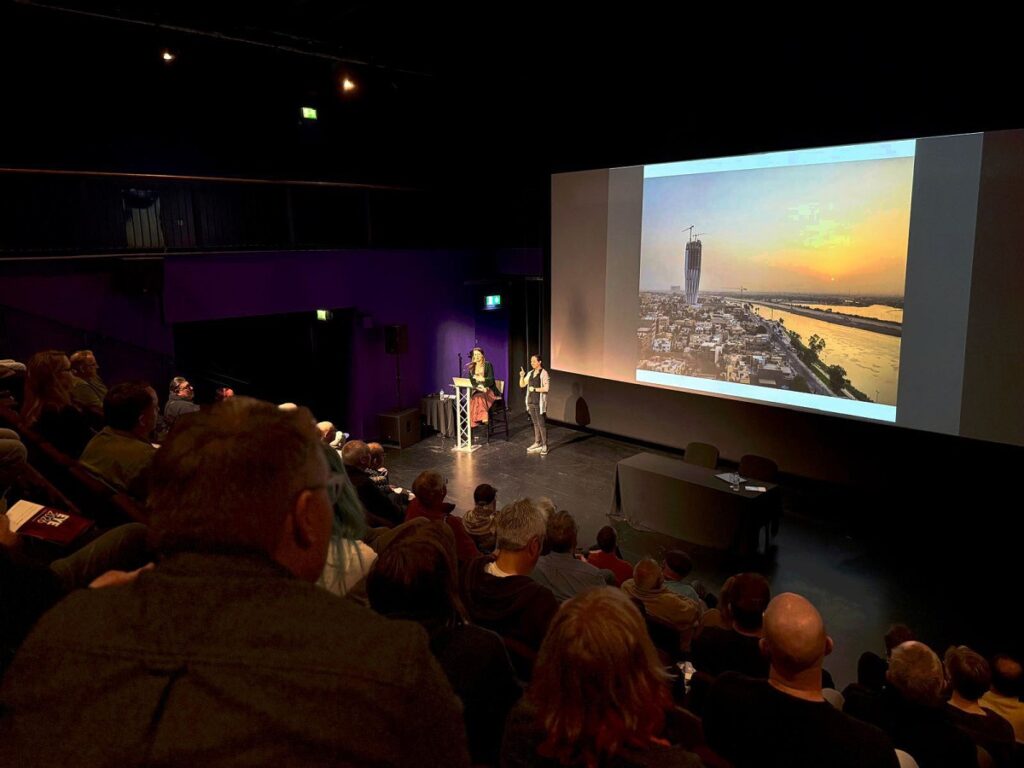
As you might imagine from someone regularly commissioned by National Geographic and the New York Times, the accompanying pictures are stunning. Garthwaite explains one particularly poignant image as showing the interior of a derelict theatre in Mosul, stripped of fittings and colonised by pigeons, where she came across a troupe of teenage boys rehearsing a self-written play about peace on the very stage that ISIS had used for public beheadings. The building was bulldozed the very next day.
Garthwaite – for whom “seeing the world in frames is utter serenity” – stresses the vital importance of photographers remaining after the dust settles on conflict, to record the rebuilding process. Those who do so, she observes, are almost always women. Committing to a country and a people rather than parachuting in and out enables a photographer to witness changing seasons and attend festivals, as well as to create rapport and understanding through simply sitting to eat, drink and talk together.
Garthwaite’s inspirational presentation resonates in Sunday’s programme, which prioritises dialogue over monologue. There are opportunities for attendees to talk to speakers Taylor, Stuart, Buitendijk and Trenberth, as well as Paul Reas and Neil Bennett, whose respective exhibitions Fables Of Faubus, Made In Newport and Australia From Above are showing at Gallery 57. Carroll sets up stall outside Clwb Ffoto with his ever-growing collection of Welsh photozines for perusal.
In the Place, Si Jubb takes souvenir portraits for free. His images from Wales and Weymouth on display suggest that he subscribes to Martin Parr’s belief that all of life can be found at the seaside, and, in their eye for the odd and the humorous, recall the work of Elliott Erwitt and Trevor Ashby.

In a similar vein, Nick Treharne’s Wales: Faces And Places spotlights colourful characters from the length and breadth of our “exceptionally diverse” nation, such as former gurning champions Orinda and Reg Morgan, and Tonypandy’s David Moon, who has converted the back of his Ford Capri into a bar and replaced the fuel tank with a beer barrel. Also available to view in Market Arcade (alongside series by Adam Davies, Rob Norman, Roger Tiley and Eleri Griffiths) is Ron McCormick’s Newport Zooport, an ongoing project that betrays the long-term Newport resident and one-time Doc Phot lecturer’s fascination with the juxtaposition of the mundane and the bizarre. One image, depicting a stretched limo dangling off the edge of a flyover like the Italian Job bus, looks like it must surely be some kind of art installation.
Which brings us back to Newport, where it all began for Stuart, Buitendijk and Trenberth – and festival founder Edwards. That the Doc Phot course produced four high-calibre professional photographers of such different approaches, styles and specialisms is testament to both the content and the staff. It may not have taught the finer technicalities of studio lighting, but it clearly capitalised on students’ latent enthusiasm for photographic practice, offering creative freedom, cultivating healthy competition and underlining the importance of interest in and engagement with the wider world.
As such, Newport seems like the Eye’s spiritual home. Huge credit to Edwards for making and managing the move, and to Newport City Council (especially Heritage and Culture Manager Emma Newrick), Clwb Ffoto, Gallery 57, the Riverfront Arts Centre, Offline and everyone else involved for helping to make it happen.
The Eye International Photography Festival, various venues, Newport, Fri 15-Sun 17 May
words BEN WOOLHEAD

