
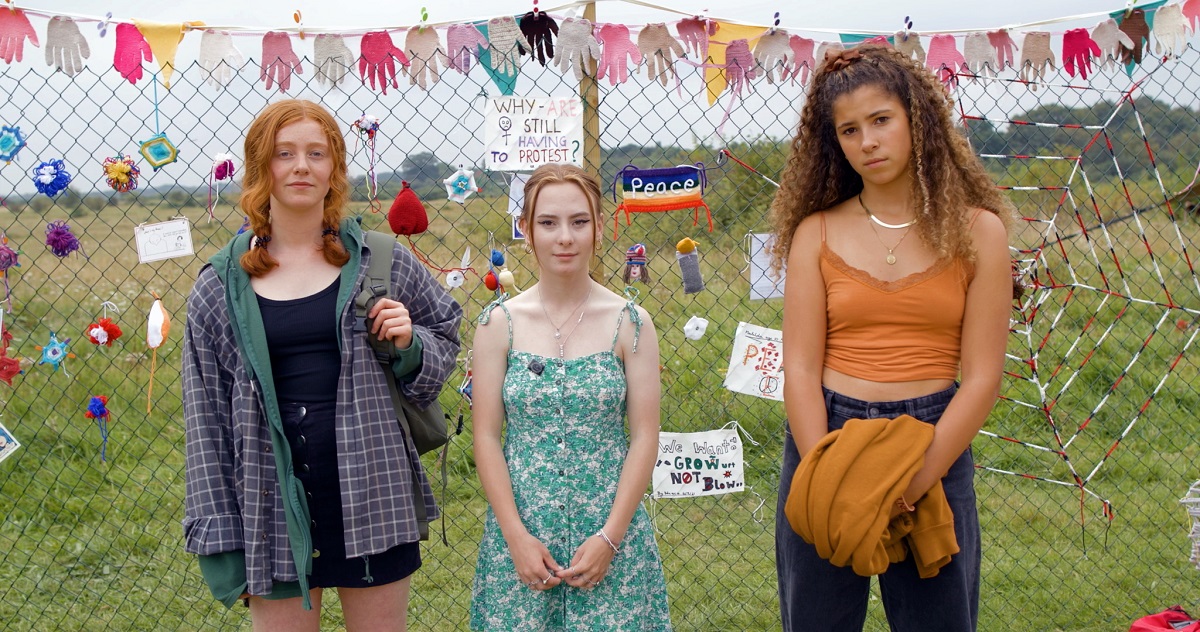
Ben Woolhead takes in a screening of Gentle, Angry Women, a documentary about the early 80s Greenham Common protests that combine a retrospective angle with the contemporary context. The film’s director Barbara Santi is also in the building to offer extra wisdom.
The most affecting narrative in Noisy Valley, Myfanwy Tristram’s new “documentary comic” about the protest stories of people from in and around the Rhondda, is that of Katheryn Edwards. Inspired by the actions of local women in Porth, the policeman’s daughter became involved in the Greenham Common protest as a teenager, living at the peace camp for a while and even spending time in prison for the cause. The experience would prove life-changing.
Not long after I’d interviewed Tristram, the book’s author/illustrator, for Buzz, Cardiff’s Chapter Arts Centre hosted a special screening of Barbara Santi’s film Gentle, Angry Women. In it, three feminist activists – teens, as Edwards was – trace the literal, political and personal journey their foremothers took four decades previously.
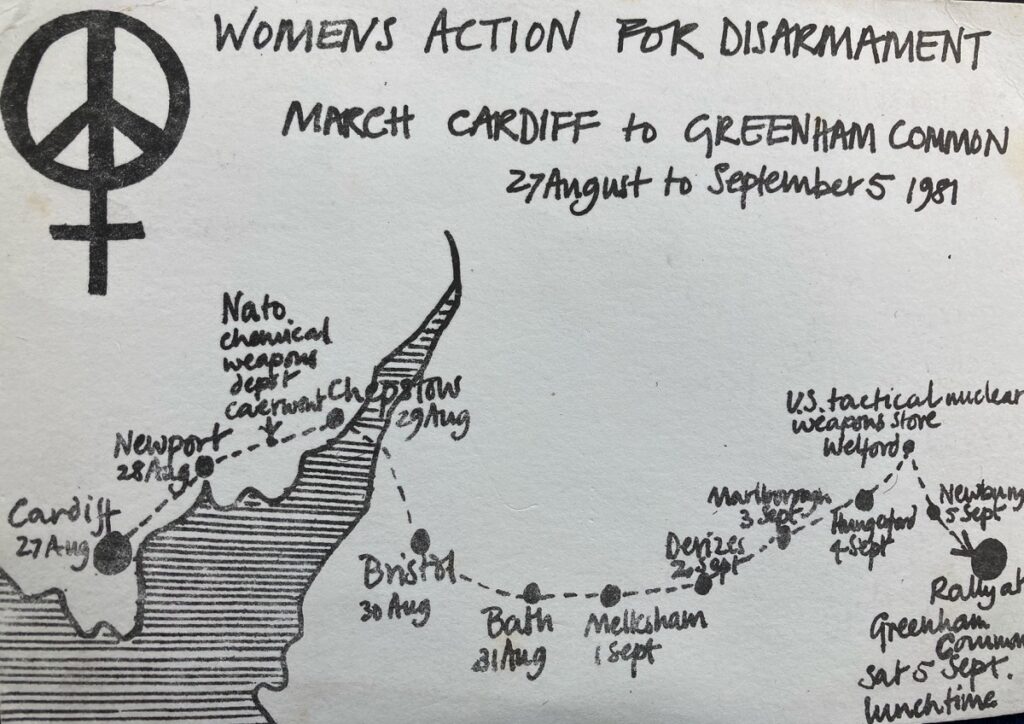
It’s remarkable (and troubling) that the story of Greenham Common isn’t more widely known – not least for its relative recency, scale and longevity. The protest, against the situating of US nuclear missiles on a military base in Berkshire, was catalysed in part by a group of women marching the 110 miles from Cardiff to the site in 1981. It lasted a phenomenal 19 years, attracted thousands of participants of all ages and walks of life, and – unlike the much more storied miners’ strike – did not become violent and ultimately had a successful outcome.

But perhaps most significantly, the protesters were almost exclusively women. One of Santi’s interviewees recalls that the few men who turned up were largely “a liability”, getting drunk and expecting the women to cook for them. The women, however, refused to allow the camp to become a patriarchal home from home.
In a Q&A after the screening, Santi admits to having known little about Greenham herself until she came across Rebecca Mordan, director of feminist theatre company Scary Little Girls, who has made it her mission to raise the protest’s profile in the public consciousness. With Mordan on board as consultant, Santi set about making a documentary that would tell the history of Greenham, but in a way that would underline the protest’s intergenerational dimension and its relevance today.

Enter three articulate, thoughtful, passionate teenage activists – politically-minded Poppy from Newport, anti-racism campaigner Xanthe from London and environmental protester Evie from Cornwall – and the idea of inviting them to recreate the Cardiff-to-Greenham walk to mark its 40th anniversary, in the company of some of those who made the trek first time around.
In the Q&A, Poppy recalls feeling increasingly angry and impotent at the state of the world in her teens, until Greta Thunberg (and a conversation with her mum) inspired her into channelling that rage into positive action. This was very much the spirit of Greenham. Fuelled by fury and defiance though it may have been, the protest remained peaceful and optimistic.
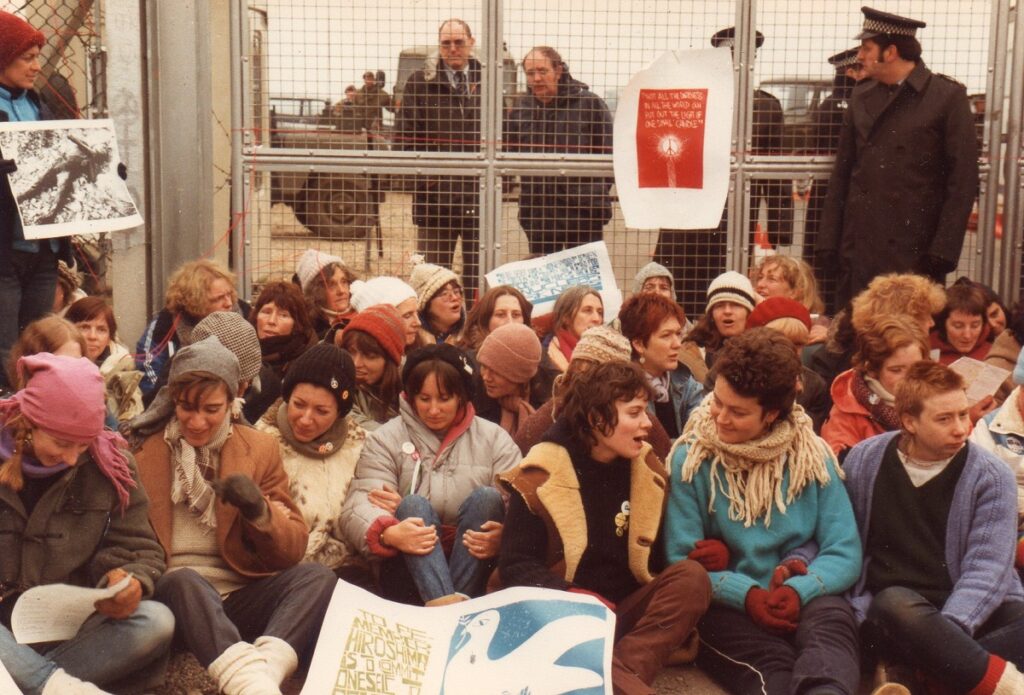
‘Community’ and ‘connection’ are words that crop up continually in the film – the latter literally exemplified in the ‘Embrace the Base’ action that saw 30,000 people encircle the perimeter fence and link hands. Another recurrent word is ‘intersectional’: the protest may have centred on nuclear de-escalation and disarmament, but as Edwards and those who feature in the documentary note, the camp was a hotbed of discussion of other interrelated issues – patriarchy, capitalism, environmental destruction.
Greenham’s consequences went beyond succeeding in its initial objective. For the very first time, many women felt that they had a voice and were able to use it to make a difference and bring about genuine change. Returning home, they understood the value of protest but also of activism in the everyday – of involvement in community initiatives striving against injustice and inequality and of simply changing their own day-to-day habits. It’s a lesson that Santi says that she has learned herself, from environmentalist Evie as well as the Greenham veterans. As Edwards puts it in Noisy Valley, “It’s about what ordinary people do. Because what we do is quite extraordinary.”
Furthermore, both the original protesters and Gentle, Angry Women’s young activists learned as much about themselves as about the world. Poppy emphasises to the Chapter audience that the recreated march created a “safe space” in which she felt comfortable simply being herself and expressing opinions. Edwards, who was able to come to terms with her sexuality in the company of the Greenham women, would no doubt wholeheartedly endorse that sentiment.
Such is the importance of the tale that Gentle, Angry Women tells, it deserves to be as widely publicised and viewed as possible – in homes and classrooms as well as independent cinemas. Santi, though, cites challenges: funding restrictions, schools failing to respond to emails, and the prohibitive costs of gaining and renewing licences for the use of archival footage.

The documentary’s significance is not merely as social and political history; its contemporary relevance is also critical. Amid tensions with Russia and the looming threat of nuclear escalation, there is a real danger of history repeating itself. For this reason, Santi says, it was important not to end on a high but to take Poppy, Xanthe and Evie from Greenham Common to the ongoing protest camp at nearby Aldermaston, where the former RAF site is heavily involved in the manufacture of nuclear weapons. The message is clear: there can be no resting on laurels. Victory may have been won at Greenham, but there remain battles to be fought. Gentle, Angry Women depicts – in the words of one veteran campaigner – the torch being passed from one generation of protesters to the next.
Gentle, Angry Women is screening at the Melville Centre, Abergavenny on Sun 28 June.
Info: here
words BEN WOOLHEAD

