
Guest commentary from Nathan Lenssen (Colorado School of Mines)
A new analysis of historical temperatures suggests that things are getting warmer faster, but what does it mean for the future?
A study (Foster & Rahmstorf 2026) was published on Friday claiming evidence that “Global Warming Has Accelerated Significantly”. This study is an update by the authors of a similar study they published in 2011 where they found no statistical evidence for an acceleration in global warming. Both studies sought to determine if there is a detectable acceleration in warming, after statistically removing the effects of ENSO, volcanoes and changes in solar forcing from the observed global mean temperature (GMT) series (through to 2024).
As I’ll discuss further below, there was no detectable acceleration in the raw GMT series – this doesn’t mean there isn’t any, but that the noise (internal variability etc.) doesn’t allow us to see if there is clearly. Thus, the study has detected an acceleration in the rate of warming of inferred long-term trends – which we can pretty confidently attribute to anthropogenic effects. This study has understandably gotten substantial attention in the media. Here, I will outline what I think we have learned from this study, what this means for our understanding of the current state of the climate system, and what it means for projections of climate change (Hint: not much).
FR26 make three contributions in this recent work: (1) the production of an “adjusted” GMT series that removes statistically estimated impacts of a few short term changes in GMT, to hopefully leave just the warming associated with changes in anthropogenic forcings, (2) the detection of an acceleration in the rate of warming on this series using three different statistical methods, and (3) a forecast that 1.5ºC warming will be reached by ~2030. The methods used here are generally sound, particularly by engaging with the state of the art in changepoint detection methods as one of the methods for acceleration detection (Beaulieu et al. 2024). The figure below shows the three statistical methods for detecting changes in trend, all of which provide statistically significant evidence that the recent trend is faster than previous trends.
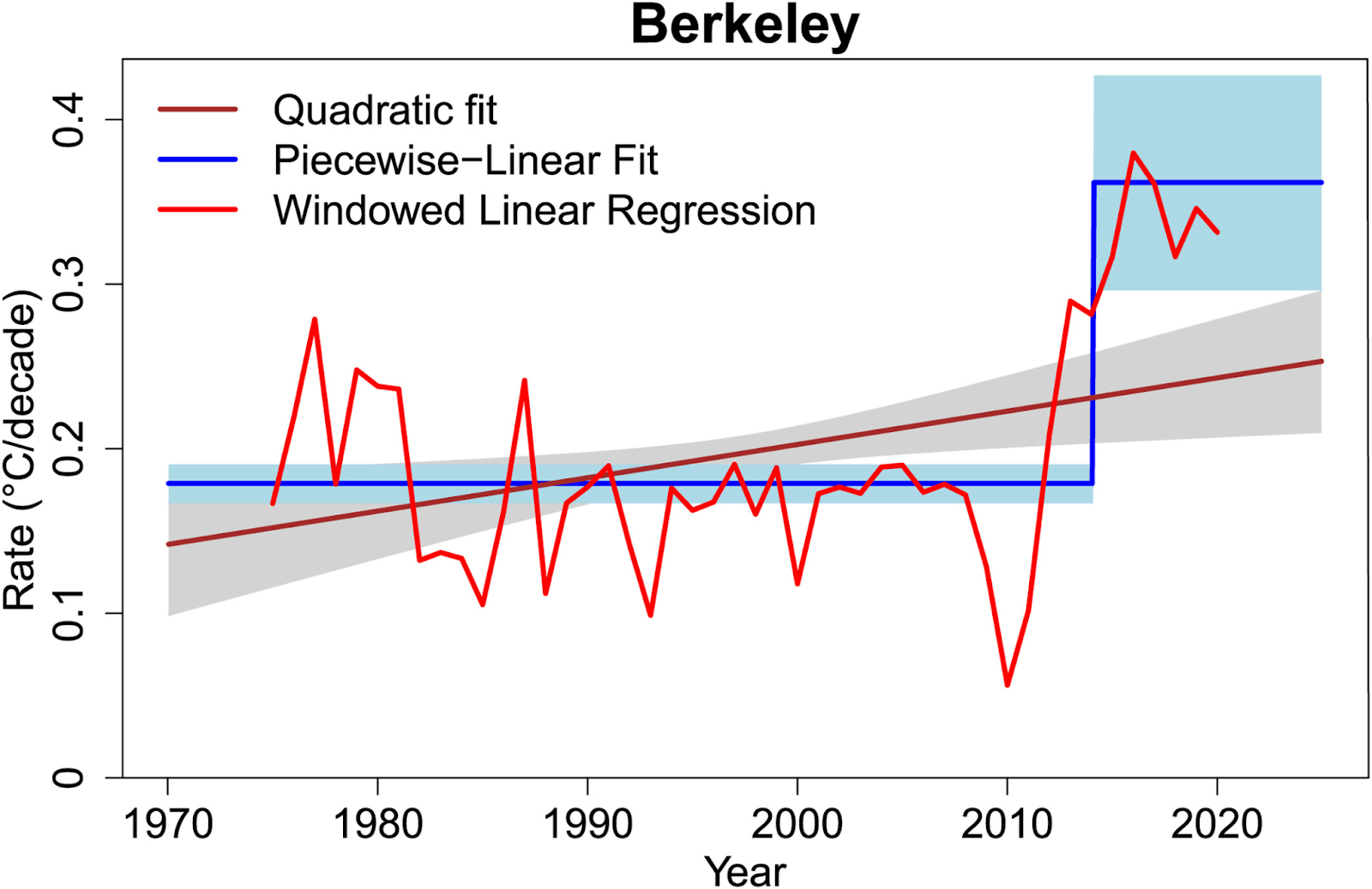
Given the assumptions made by the authors, this provides statistically robust evidence that acceleration has been detected. On first glance, this may be surprising or alarming as, to the zeroth order from our understanding of the Earth’s system’s response to CO2, we expect a roughly generally linear warming in GMT given the exponential rise in CO2 due to the log-scaling of GMT with CO2. Acceleration could be the result of the decrease of cooling anthropogenic forcings (as is hypothesized for some regional accelerations detected in Beaulieu et al. 2024) or substantial feedbacks/tipping points that are causing the Earth to warm faster than the simple CO2 forcing physics dictates. Note though that the climate models that are used to inform our future projections also expect an acceleration around now (of course, given the assumptions that went into them).
However, as the authors point out, their method of ‘removing’ ENSO could be improved (for instance, Compo and Sardeshmukh (2010)), and there is still some imprint of natural climate variability in their adjusted time series. Note that an estimate of the “true” natural variability of the climate system, and correspondingly the “true” forced response, is one of the white whale problems in climate science! FR26 does an credible, but necessarily imperfect, job of isolating the forced response, but don’t account for this uncertainty in their statistical tests.
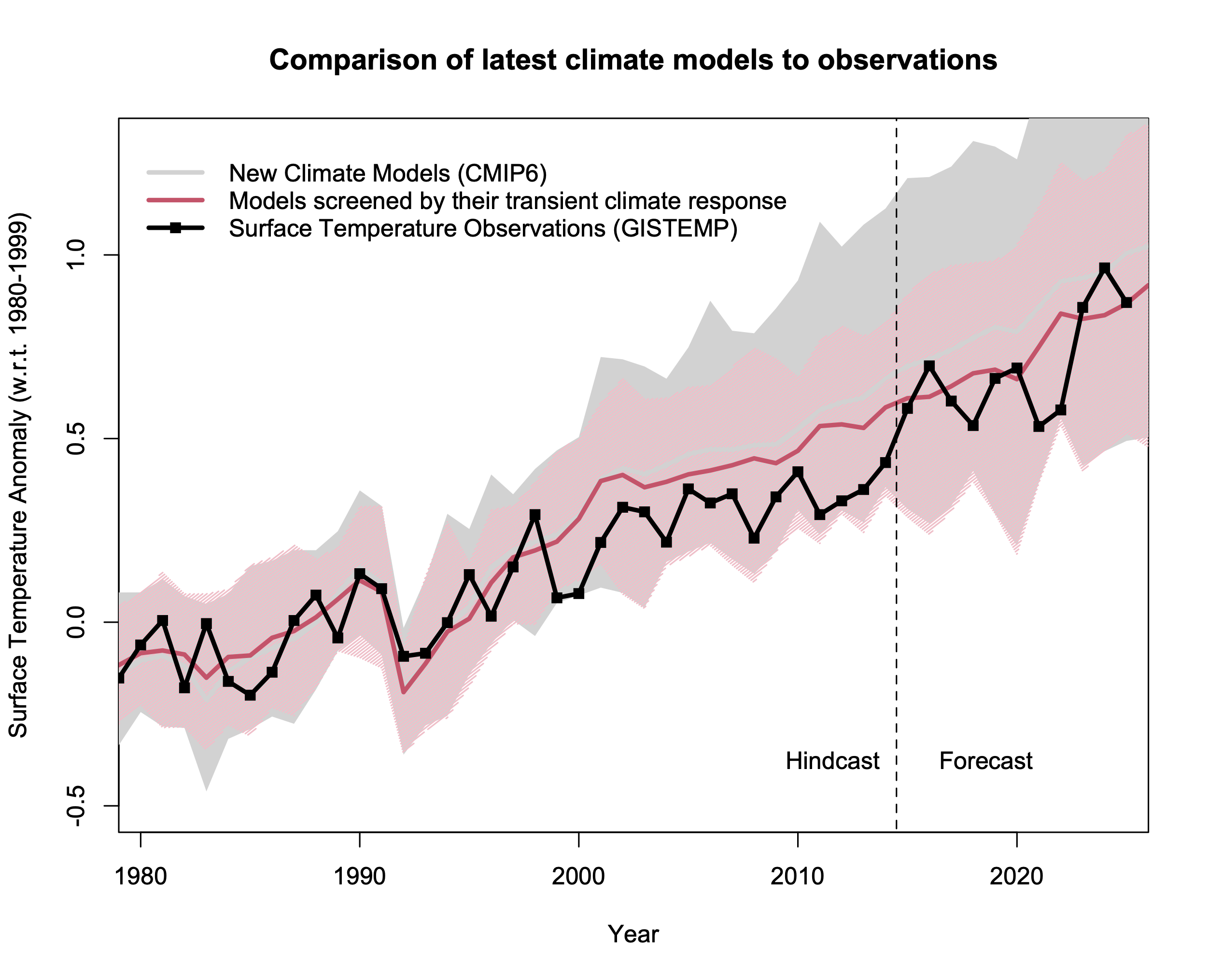
While we can’t know the true internal variability perfectly, we have climate models which provide an estimate of this variability. The figure below shows that the CMIP6 models (screened for a likely Transient Climate Response (TCE)) have a spread that fully contains the observed climate signal. Notably, the ensemble mean of these models demonstrates a slightly greater than linear warming (minus the effects 1991 eruption of Mount Pinatubo).
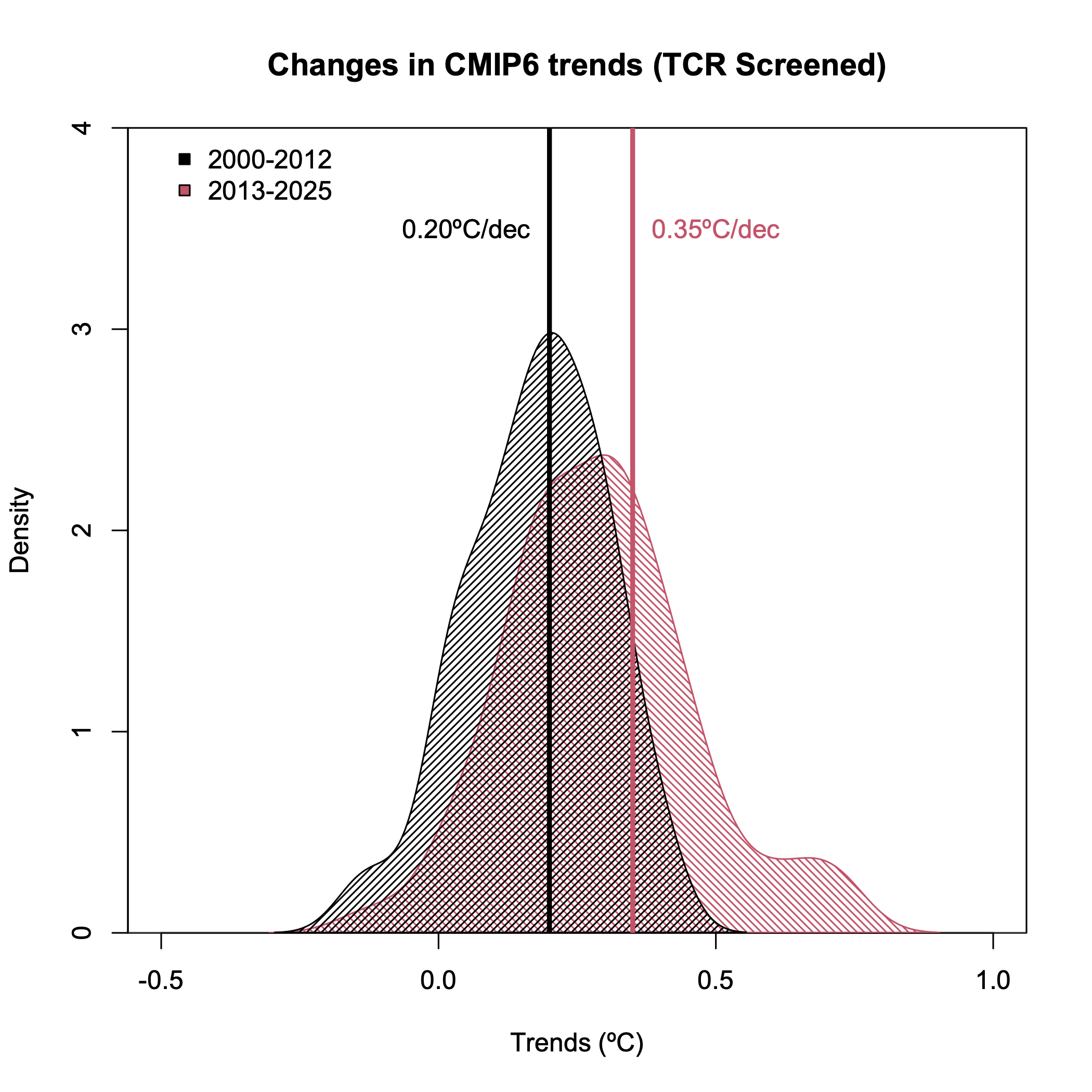
We can look at this more closely. If we look at the trends in individual model simulations for the last 13 years (2013-2025) and the 13 years before that (2000-2012), on average, the models show a slight acceleration over the same period highlighted by FR26 (0.18ºC to 0.30ºC). However, while there is a difference in the mean of these distributions, they are not clearly separate. This shows that, at least in model land, the acceleration in trend (given the internal variability and model uncertainty) is going to be difficult to detect. Note that comparisons between the models and the real world are complicated by any divergences in the forcings in the scenarios (designed more than 15 years ago) and what actually happened (Hunga Tonga, the IMO regulations, Chinese aerosol decreases etc.).
So where does this leave us? There is no detectable acceleration in the raw observed GMT, but there is an acceleration in GMT when removing the linear effects of ENSO, volcanoes, and solar variability, and there is slight acceleration in GMT when estimated using a multi-model ensemble of climate models. John Kennedy recently discussed some of these results in the context of FR26, expanding to a wider discussion of estimates of warming rate. He hits the nail on the head by pointing out two key open questions: “If there is an acceleration, what is physically driving it?” and “What will happen to the warming rate in the future?” The question about mechanism is key to trustworthy predictions of the future rate, and this is not addressed in the new paper.
The prediction of 1.5ºC warming by ~2030 made in FR26 is made in this context by estimating the rate of warming in this adjusted GMT. While made in the imperfect context discussed here, this estimate is reasonable when compared to a more comprehensive attempt to estimate this date . However, as John states, we already know the planet was warming, we have some evidence for acceleration, but we need a better path forward to predict how GMT and subsequent regional climate will change under continued CO2 emission
References
G. Foster, and S. Rahmstorf, “Global Warming Has Accelerated Significantly”, Geophysical Research Letters, vol. 53, 2026. http://dx.doi.org/10.1029/2025GL118804
G. Foster, and S. Rahmstorf, “Global temperature evolution 1979–2010”, Environmental Research Letters, vol. 6, pp. 044022, 2011. http://dx.doi.org/10.1088/1748-9326/6/4/044022
C. Beaulieu, C. Gallagher, R. Killick, R. Lund, and X. Shi, “A recent surge in global warming is not detectable yet”, Communications Earth & Environment, vol. 5, 2024. http://dx.doi.org/10.1038/s43247-024-01711-1

