
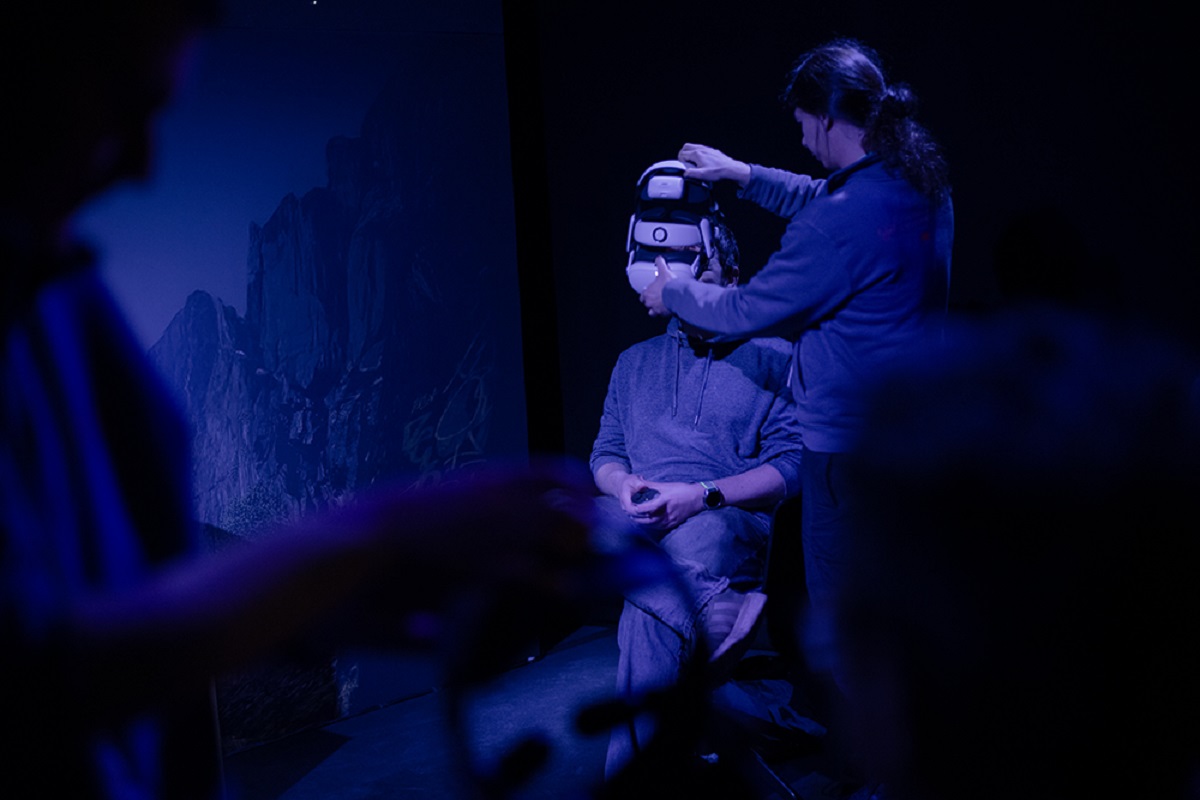
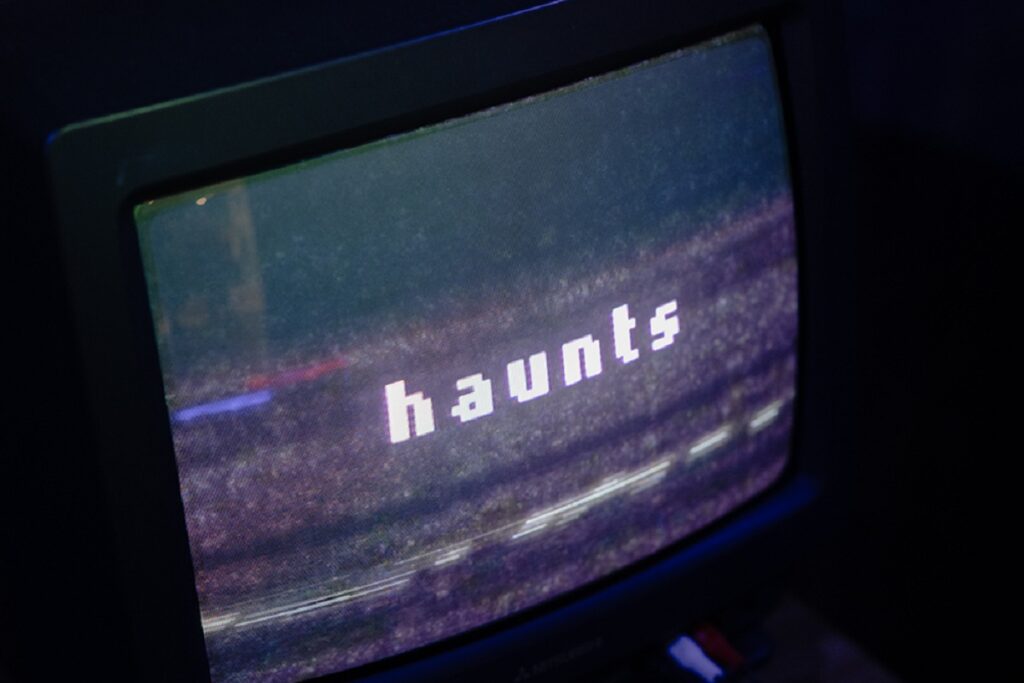
Haunts, a virtual reality installation narrated by Callum Scott-Howells in English and Steffan Donnelly in Welsh, is running at the Wales Millennium Centre in Cardiff Bay until Sun 12 Apr. Amy Ford followed up a previous interview with its co-director Tom Chetwode-Barton by further quizzing Lucy Hammond, creator of the Haunts concept, and executive producer David Massey.
Briefly explain the concept behind Haunts.
David Massey: A nostalgic, stream-of-consciousness experience that follows the story of 16-year-old Morgan, who is exploring his identity against the backdrop of a rural landscape. In this instance, Morgan’s reality is defined by music, distorted archive footage, photographs, digital art and virtual environments.
What is the inspiration behind the experience? And why now?
Lucy Hammond: The idea of where hangouts are in the modern day, compared to where they were in the 2000s. Where are the spaces and places that teenagers will be nostalgic about in the future? As a young person from a rural area, especially somewhere like north Wales, the kind of loneliness of some of the places you have to hang out when you’re a teenager – the bus stop, or a wall outside your corner shop – and your relationship with the landscape is really interesting.
In the story Morgan, our lead character, talks a little bit about being in between places, and I think there’s something kind of incredible about the idea of a haunt being imbued with power – the ghosts of all the people that have hung out there before. As a teenager, you’re between childhood and adulthood, so there’s a sense of movement and transition. That’s the space we’re trying to explore with the piece – that strange moment when you’re on the cusp of something, discovering yourself, and how you might remember that when you grow up.
For young people now, a lot of their shared spaces are digital; many people who originally opened a Facebook account have now deleted that. And what does that mean when some of your hangouts may not exist in the same physical way in the future?
David: The concept and pitch came from Lucy, at a time when we were in talks with the National Library Of Wales about granting artists the opportunity to explore the Wales Broadcast Archive. We started to explore how Lucy could mentor an emerging director from Wales, charting their life and cultural identity. Once we pitched the idea to the National Library – who’d been given Heritage Lottery Funds to support creative work using the archive – we went about seeking a Welsh director and writer [Tom Chetwode-Barton] and built a team! Lucy had worked with Dreaming Methods previously and loved their approach, so we wanted to collaborate with them on Haunts.
How did Callum Scott Howells become involved with the project?
Lucy: He came to our minds straight away. We just thought he’d be brilliant. He has this incredible track record of playing these really interesting queer characters. His performance in It’s A Sin, especially, was amazing, and he was the MC in Cabaret. He’s a really recognisable voice but also has this really great history of delving into characters like Morgan and kind of thinking about that mindset. He got stuck in with the script straight away and totally got what we were trying to achieve with the piece.
David: When Callum walked into the studio he was instantly present and an absolute joy, quickly understanding his role within a VR context, inviting audiences into the world that we were creating. Speaking to audiences is his power: meticulously framing each scene, guiding audiences gently through this personal yet very familiar story.
What does nostalgia mean to you – are there any examples of everyday things that make you nostalgic for another time?
Lucy: Any time an indie band from the 00s comes on the radio – the Libertines or even the Pigeon Detectives – that always makes me feel really nostalgic for that time. It felt very exciting and very sort of particular to young people to be into that music, like you were discovering all these bands for the first time, even though they were all heavily influenced by previous decades.
The other thing, which I think a lot of people relate to, is the theme tune to the Antiques Roadshow. It’s still on! I remember hearing that and thinking about going to school and college the next day – sort of bittersweet, a bit worried about what that week might hold ahead.
How did the combination of partners you worked with on this project – National Library Of Wales and Dreaming Methods, plus the musicians – bring your ideas to life?
Lucy: Tom and I visited the National Library Of Wales to look at the Wales Broadcast Archive, and there’s something about the wealth of footage from the 00s – even though it’s sort of in our recent history, fashions are so different, the way that teenage activities are discussed and looked at, the idea of indie bands and music culture, small gig spaces… that kind of thing was really interesting. In Haunts, you’ll see a couple of really interesting clips of people playing music either in their bedroom or at small gigs.
David: It was important for the music to shape the work, driving audiences through a familiar soundscape featuring Morgan’s eclectic playlist. Alongside this we had the titanic talents of Judi and Andy from Dreaming Methods, who took all of these ingredients to reimagine this vision in a way that feels rooted within Wales. Using archive, virtual environment and landscape, they carefully led on story design, the creative concept and its realisation for VR.
What are you hoping people will feel after experiencing Haunts?
David: I’m hoping that audiences will come away feeling as if they’ve inhabited a world for a fleeting moment that might feel distant and familiar. For many it might feel like a sucker punch or a bittersweet tale. Within the exhibition, I’m hoping it will create a conversation and naturally challenge conventions around new forms of storytelling.
Lucy: That people feel transported to another place and to another perspective, just for a short time. Happy to have stepped into someone else’s shoes, and ready to reflect on whatever their teenage years and haunts mean to them.
What’s next for you both?
Lucy: I’m currently pulling together another virtual reality project with Pilot Theatre, the company I’m immersive director for. Not sure when it’s going to go into production, but I’m working on that at the moment. And Pilot also have our theatre tour of Noughts & Crosses [across England throughout April and May].
David: At the Wales Millennium Centre, we’re working hard on producing Annwn – a new prize dedicated to immersive storytelling. Four shortlisted works from the UK, USA, Greece and France will be showcased as part of a major exhibition in May and June. We also have a couple of new XR productions in development that we plan to launch in 2027 and 2028.
Haunts, Wales Millennium Centre, Cardiff Bay, until-Sun 12 Apr.
Admission: FREE. Info: here
words AMY FORD

