
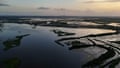
When a study in May concluded that New Orleans has hit a “point of no return” due to the climate crisis that will require people to eventually retreat from their storied yet ultimately doomed city, the local reaction was swift and fiery.
The onward march of rising seas around a sinking city was unsettling, but the study is “more focused on generating publicity and clickbait headlines” than coming up with solutions, said Helena Moreno, New Orleans’ mayor. There is flooding in Miami, and wildfires and earthquakes near San Fransisco, Moreno pointed out, “yet no serious movement exists to declare those cities lost causes”.
Others were less diplomatic. “It’s really the most ridiculous study I have ever seen,” said Gordon Dove, the head of Louisiana’s coastal restoration agency, who took aim at Torbjörn Törnqvist, the lead researcher. “I don’t think he knows what he’s talking about,” Dove fumed.
Some locals took to posting defiant video clips of themselves near New Orleans’ levees (including ones carrying captions such as “STOP TELLING US TO MOVE”), or lamented a “modern day redlining of an entire city” and asked what will happen “when investors, insurers and young families read this” and act accordingly.
Others decried the climate denial by state and federal governments that has led to such a situation.
But of the torrent of New Orleanians who got in touch with Törnqvist about the study, typically after reading about it in the Guardian, most have grasped the precarity of the city’s future, according to the Tulane University academic, who is a leading expert on the fraying marshlands of the Mississippi Delta.
“I’ve found it encouraging – we’ve had more constructive reactions than negative ones,” Törnqvist said. “Of course it’s upsetting to hear this, but cities like New Orleans have an expiration date. We’ve already crossed a tipping point of survivability for our coastal wetlands, the rate of sea level rise is way too high.
“We will be surrounded by open water and New Orleans will be like a fortress in the Gulf of Mexico. It will be like Venice, a few islands in a lagoon.” A decision by Jeff Landry, Louisiana’s Republican governor, to cancel a $3bn project to naturally revive the vanishing coastline with sediment carried by the Mississippi is a further “death penalty” for New Orleans, Törnqvist argues.
The process of encirclement, Törnqvist and his fellow researchers stress, will still be a gradual one taking several generations. Protected for now by billions of dollars’ worth of levees, pumps and flood gates, New Orleans doesn’t face the immediate pressure of evacuation.
But a galloping sea level rise beside low-lying land that is rapidly eroding as well as subsiding will only end one way, the study warns: the Louisiana coastline moving as much as 62 miles (100km) inland, swallowing the New Orleans region in the coming century or so.
“The general sentiment is that we are here, and we want to stay,” Törnqvist said. “I get that – I live here and I’m not planning on leaving. But we need to think differently about the city and relocation. It will be an incremental process that involves a lot of steps. We might not know how to do it but we will have to figure this out. Let’s try to embrace it rather than deny it.”
Relocating a city of the size of New Orleans is unheard of in the US, which has no national strategy for the growing number of people displaced by crumbling coastlines and extreme weather. Even much smaller resettlements of vulnerable towns in thawing Alaska have been plagued by problems, with Donald Trump’s administration slashing programs that help communities escape the fallout of an overheating planet.
But for some in New Orleans, the relocation question can no longer wait. The city is already losing people – shrinking in four of the five last years, now at just more than 360,000 people – for a host of reasons. That includes some of the highest rates of home insurance in the country due to the risks of living on a bowl-shaped spit of marshland below sea level, surrounded by water in a hurricane zone.
“We are an indicator species – soon, other people are going to have stranded real estate assets and nowhere to turn,” said Steve Picou, a musician and environmental planner who with his wife, Grasshopper, moved from their longtime New Orleans house three years ago after their annual home insurance rates jumped from $900 to about $9,000 over the past two decades.
“The whole concept of relocation is overwhelming for people, they don’t like to think about it,” said Picou, who moved to Opelousas, which sits 130 miles north-west of New Orleans at a more comfortable 66ft (20 meters) above sea level. “But there’s no escaping this climate. Towns are going to have the opportunity to be receiver communities and they need to start thinking about that now.”
In a striking new response to this prospect, a loose coalition of New Orleans community groups have in recent weeks traveled to assess two cities that could provide potential escape routes – Vicksburg and Natchez, both situated roughly three hours away by car in neighboring Mississippi.
Debra Campbell, the chair of the main non-profit – A Community Voice, which has about 9,000 members in New Orleans – said there’s nascent interest in acquiring or building properties for New Orleanians to flee to should they be displaced by a storm similar to the devastating Hurricane Katrina, which hit the city in 2005.
“We’re only going to leave if we’re forced to leave due to hurricanes, flooding and the heavy industrialization of our neighborhoods,” Campbell said. In arranged meetings, residents and officials in Vicksburg and Natchez welcomed of the idea of an influx from New Orleans and discussed the renovation of empty homes and use of public facilities as temporary shelters, she added.
“I told them, ‘We’re coming. We’re coming in an exodus,’” Campbell said. “We’re not coming to lay on your leg – we’re looking for employment. We want our kids in school. Once we’re pushed out of here, we have to have somewhere to go.” The Mississippi cities “don’t have what we have” in terms of climate-driven threats, she said.
Few people in Campbell’s majority-Black neighborhood – the Seventh Ward – want to leave New Orleans permanently, she said. So A Community Voice is searching for private funders to secure properties that could act as a sort of climate refuge for people to retreat to if uprooted by disaster.
“Nobody wants to leave home,” she said. But she added: “We do know if something hits like Katrina, it will be a while before we can return. There may come a time where we can’t return home. This place will be underwater and no longer exist.”
Any move inland away from coastal erosion and the frontline of hurricanes growing in strength as the planet heats up would reduce exposure to climate risks and their associated costs, according to data provided to the Guardian by Cotality, a property intelligence company.
In risk scores based upon floods, storms, earthquakes and other perils, New Orleans is at the most severe rating of 100, Cotaility found. That is about 25 points higher than Natchez and Vicksburg, and double that of other inland cities in the region such as Montgomery, Alabama.
“It’s the city with the highest hazard risk in the country,” said Howard Botts, Cotality’s chief scientist. “The city is essentially a bowl surrounded by levies, and water will accumulate within that.” New Orleans fills up very quickly if drainage pumps aren’t able to remove the water outside the bowl, as was seen during Katrina, Botts said.
after newsletter promotion
New Orleans is “culturally so significant” that the federal government, which has already spent $15bn on flood protections after Katrina, will spend even more to shore up defenses even if the tax bases shrinks further, Botts said. But the cost of staying dry will add up, through new infrastructure and steepening insurance premiums.
“If everyone in New Orleans decides not to retreat, what would it take to stay – taxes on businesses, boats instead of cars, elevated homes?” said AR Siders, an expert in coastal relocation at the University of Delaware.
“Something big has to change and people in New Orleans will have to choose to become like Venice or have 30ft levees and not see the coast. Something will have to give.”
New Orleans could decide to just defend its historic, tourist-thronged core, or gradually shift its center of gravity northwards over decades with tax breaks and other incentives to encourage housing, businesses, schools and hospitals on higher ground, safer from inundation.
There is time.
But any measured approach would require the sort of long-term strategic commitment now rare in US politics.
“There is no blueprint at all for this. I’ve been told before that retreat is un-American,” Siders said. “Most glaringly there are no state-level plans for this – we are waiting for one state to be brave enough to commit and take action.”
“My fear,” Siders said, “is that that a lot of US towns are facing a slow death. Slow demise is the default, not just for New Orleans but for Miami and Wilmington and lots of other places. I’m worried we are all sitting around and hoping, playing chicken and hoping that someone else will come in and solve the problem later on.”
Such decisions about the future of places including New Orleans will be shaped by the unrelenting changes wrought by the climate crisis – as well as more human feelings of connection to home.
New Orleans is famed for jazz, Mardi Gras, beignets and its Creole culture. But it is more than just this – it exists as a place of memories and family and belonging like almost every other city. For many who live here, the onus is to cherish and to build rather than to contemplate retreat.
“We need investment,” said Arthur Johnson, the chief executive of the Lower Nine Center for Sustainable Engagement and Development in the Lower Ninth Ward, an area badly ravaged by Katrina. “If you talk about leaving, it can be an excuse to not have economic development because you don’t have enough people, particularly in this community. Where do you move anyway? Where’s affordable?”
The physical manifestation of the determination to hold back the rising seas is the string of fortifications that ring New Orleans. A linchpin in the system is the Lake Borgne Surge Barrier, a colossal, 1.8-mile-long concrete and steel structure known as the “great wall of New Orleans”.
Its huge, 25ft yellow boom gates can swing shut in a few minutes to cut off a commercial canal and prevent a crescendo of water from the Gulf barreling into the heart of New Orleans, lying some 15 miles to the west.
By any measure, these defenses have performed well since Katrina, seeing off the threat of more recent hurricanes, such as Ida in 2021. Standing on a parapet atop the hulking surge barrier on a typically steamy Louisianan June day, Jeff Williams looked out as a leviathan barge conveying equipment for Nasa’s Artemis III project, being constructed a short distance inside the barrier, chugged through the open gates.
The money spent on the surge barrier and Nasa’s Michoud Assembly Facility is evidence the federal government won’t just let New Orleans drown, believes Williams, who is the regional director of the Southeast Louisiana Flood Protection Authority, tasked with maintaining the flood defenses.
“I don’t believe it’s a lost cause – I believe it’s a question of investment,” he said. “Southern Louisianans, long before this country ever even existed, have always adapted, always. Technology has changed. Engineering has changed. So the adaptability is there.”
Still, the funds will need to keep rolling. The levees, like the rest of New Orleans, are slowly sinking into the soft soils and so another $1bn is needed to add a foot or two in height in certain places to keep pace.
Williams likes to show people a cross-section picture of New Orleans sitting in a depressed dish with water sloshing above it, to underline the stark, Sisyphean challenge of living below sea level.
“You can design for whatever you want, but we’re just in the risk reduction business,” Williams said. “Flood protection is in our name but we don’t like to use those words. We talk risk reduction.”

