
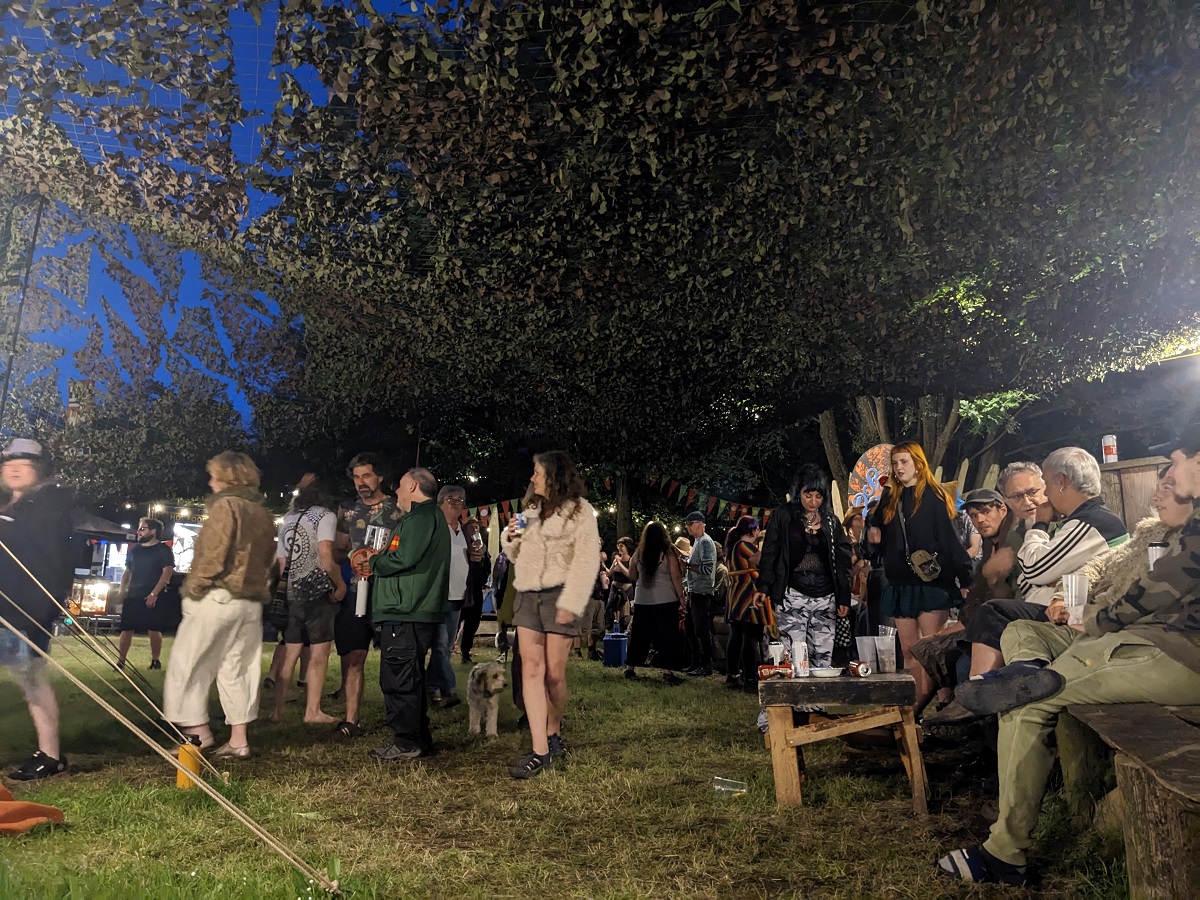
Whirling dervish of the Welsh underground festival circuit, Julia Deli, went to north Powys in late June for her latest such weekender, the Workhouse Party in Llanfyllin. Her report of the fun to be had in and around the site have been split into four segments, all running this week – first up, here’s a review of everything from bands and DJs to food trucks sampled as she went.
A misstep on the platform at Welshpool was the equivalent of the folkloric ‘stray sod’ or ‘fairy turf’: tread on a spot of tricksy earth, there’s a shiver and you’re suddenly in an ancient fairy realm. It couldn’t be more true of the magical landscape around Llanfyllin’s Workhouse – Y Dolydd in Welsh – where a beautiful, old-school tribe spent this year’s Solstice together, at the Workhouse Party.
The venue has previously hosted a whole range of other shows and events, such as Kippertronix and a steampunk gathering. The historic Victorian building, the UK’s best preserved workhouse, has a free museum and tours plus a bunkhouse and campsite which help fund restoration. Meadows Cafe makes the centre a hotspot for locals and people touring the region.
With folk, metal, dub, soul and psych on the menu, creative use of intimate spaces makes many mini-worlds to immerse yourself in. Mascot Moth are up first on the Courtyard stage, filling the old stones with their eclectic palette, shamanic shenanigans and distinctive, yet ever-evolving soundscape. New releases are timed to coincide with Mother Earth’s cycles – with a sneak peek before the following day’s peak solar energy.
When Pwllheli’s Pys Melyn take over, we’re on a pilgrimage through retro psychedelia, desert blues and jazz. Dream-inducing vocals, hypnotic percussion, political poetry laconically delivered and underlined by Ethiopian ska sax: they’ve been ploughing their own furrow since they were teenagers who set up their own record label before they could legally gig.
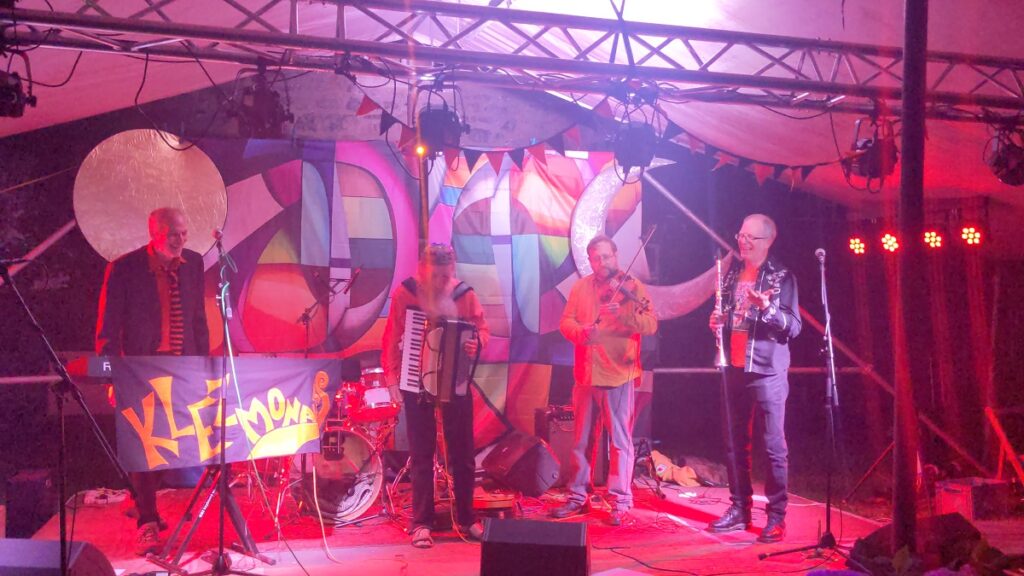
From over the hills in Llanidloes, Klezmonauts always bring the party. The five-plus-piece band keep us moving with the lively, complex rhythms of Oriental Freylekhs from the Eastern Mediterranean, a klezmerised version of Cerys Hafana’s Dawns Elmo, and a slow, spiralling Balkanised hora in traditional Jewish style. There are so many rhythms, we can each find our own.
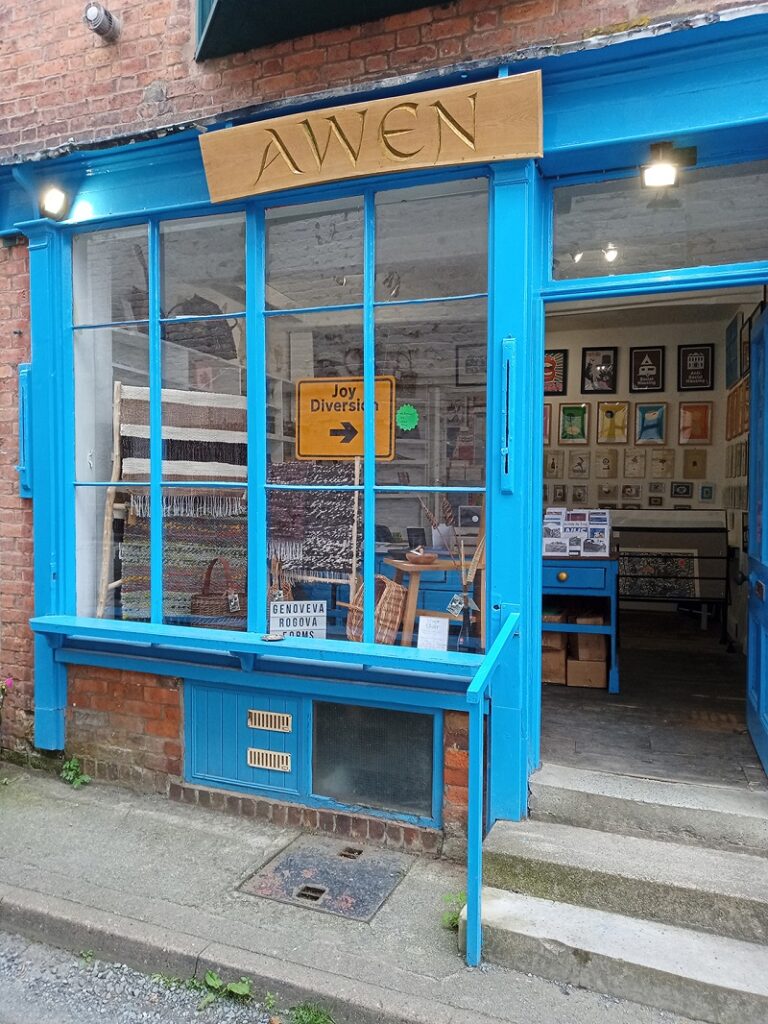
Oriel Awen Gallery, on the aptly-named Narrow Street, is hosting the Solstice opening of an exhibition by Meinir Mathias. An independent collective of local artists recently opened the gallery, restoring an old, empty town building to life; it’s become a centre for contemporary Welsh works and in January, Julie Murphy launched her Retrospective album there. One of the collective, Brian Jones (who uses the alias Joe Punk as an artist), gives me a copy of The Chronic – a new magazine stuffed full of local art, poetry and political thought.
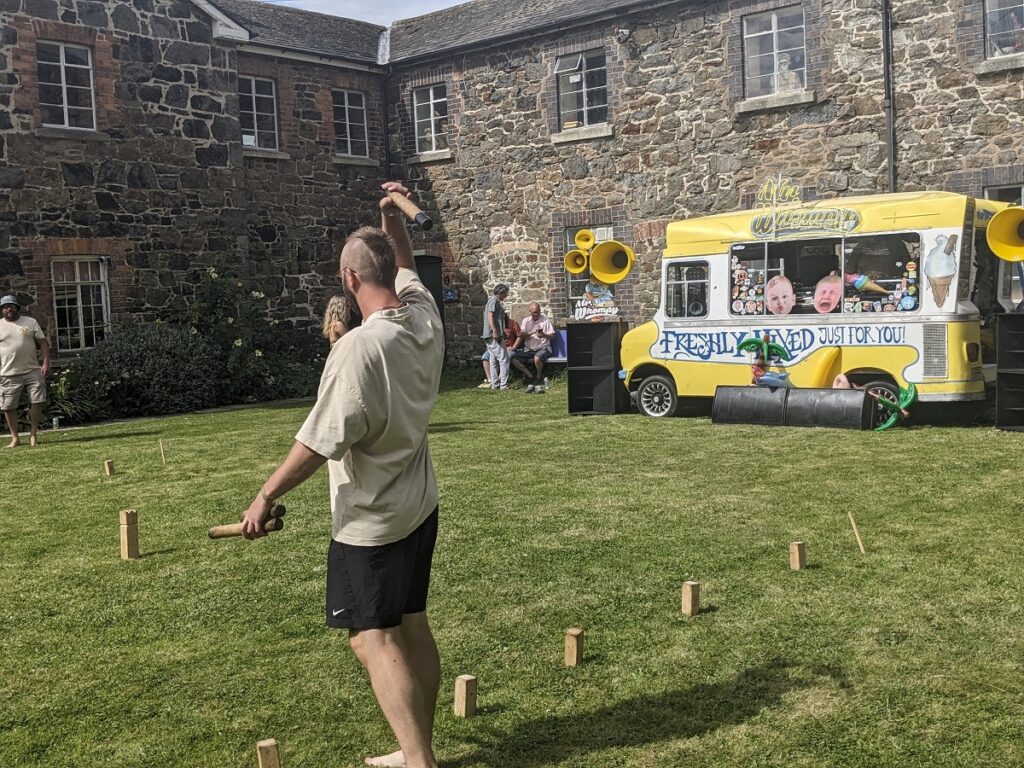
Back onsite, we’re welcomed by Mr Whompy’s Ice Cream Van soundsystem, dolloping vintage soul and reggae out with the sunshine, and the warm dub, Balkan jazz and Hindi film music of Passenger, blending under oaks in the Dub Shack.
As shadows lengthened in the Courtyard, Owen Shiers’ mellow guitar resounded from the walls as he played Can Dyffryn Clettwr, a song about his Ceredigion birthplace. Describing how archival ‘tips’ come his way, he tells us, “I was in Talybont’s White Lion after a gig, and a member of the audience came over to tell me they’d been bequeathed a songbook containing 120 Welsh folksongs – from a competition to collect folksongs at an Eisteddfod. We do like a competition in Wales…” The sweet tune he plays describes the joy of escaping from worldly problems to a tiny mountain cottage, and segues nicely with a rendition of Calon Lan.
Next up are Cadi and Bryn: Welsh triple harpist Cadi Glwys Davies, who hails from this valley (and whose grandad was Wales goalkeeper Dai Davies, fact fans), plus accordionist Bryn Davies from Meifod. They’re part of Twmpdaith, the touring collective of folk musicians and clog dancers, and we get instructions to do-si-do, and form quarters “posh posh” – whereupon we stick noses in the air and high-step like horses as if we’re in a Jane Austen adaptation.
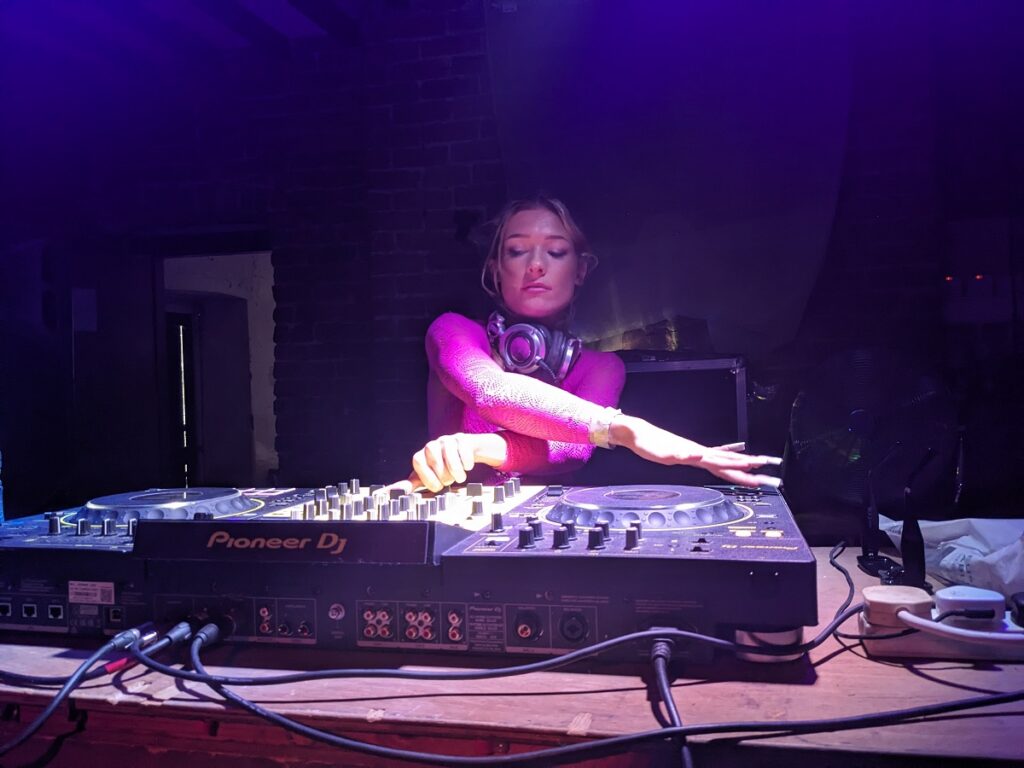
In comparison, a d’n’b version of The Wheels On The Bus injects humour into Candy Mix’s Dub Shack set, playing out with a nod to the Eastenders theme, before Quality Tom gives us crunchy Balkan dubstep and electro-Brazilian beats. Revolution and Regenerate’s DJs are also mixing frantically for excitable crowds, Darren Williams and Courey Mounsey rolling fat beats and soulful funk in another courtyard – it’s that moment in the festival when all the sounds seem to blend into the giant om of meditation.
Emerging out of the chant and onto the main stage are Cardiff’s Epileptic Lizards. Vocalist and keyboard player Jo Mountain addresses the audience thus: “Time to get your hips groovin’, that’s it boys and girls, come to the front… this one’s called Doomed.” Both hip-hop and downtempo tunes have spooky chords, darkly meaningful monologues and the funkiest bass, with Alien Sex Party being the biggest crowdpleaser.
A wander round the site saw fairy lights twinkling in the groves, Solstice finery emerging from all corners, and Gini – semi-resident DJ at Rhayader’s Lost Arc – offering dubbiness and calypso in the Dub Shack. Pen Y Lan Community’s homemade ciders and elderflower champagne go down a treat with the gentle folk jams at the bar, and so far no-one had used the self-proclaimed soapbox for anything other than sitting…
A crimson Solstice sunset, with a quarter moon riding in it, was the backdrop for Machynlleth electropop duo National Milk Bar. With sequins all out for the spangling notes of Chuzz’s keyboard and Sash’s sax and vocal, waves of emotive and anthemic sound wash over us, going into overdrive for a week-old song titled Burt Reynolds And A Ford Capri. Twmffat’s Ceri Cunningham gets a linedance going for Erasure’s Stop, and a stridently strutting revision of Roxy Music’s Love Is The Drug reminds us there’s nothing better than dancing in a field at midsummer.
On Sunday morning, I walked a circular route to Derwlwyn, a grove perched on the steep valley side. Mysterious rocky outcrops were hidden overhead by a filigree of tree limbs – fairytale oaks twisting in all directions, mossy caverns among their roots for the Twlwyth Teg. A sign to the famous ‘Lonely Tree’ was a challenge for another day.
As the Cain Valley closed in until only one narrow, freshly-cut field stood on either side of the river, a footpath returned us over a wooden bridge to the campsite. It was great to talk to Alex Jones, Llanfyllin resident and Workhouse enthusiast. He hadn’t meant to stay in the town when he found a house there nine years ago, but was captivated by the place – and has found it “a boon and a blessing” for his PTSD and chronic fatigue.
“St. Myllin’s Well is what really drew me to live here. It’s set in very lush surroundings, and has beautiful views of the town below, the Cain Valley and the circle of hills. The impact the surroundings have on the community filters through into people’s mindsets – it’s a very down-to-earth, close-knit, caring and knowledgeable community. It’s really easy to communicate with people here, and everyone has time for each other.
“There are so many walking routes, and I’m still discovering uniquely beautiful places. They all have a fey, Druidic atmosphere – ancient trees, covered in moss, each one representing such biodivesity. There’s a densely-packed woodland called the Dingle that’s almost Scandinavian in quality. Going on these walks has really helped me gain ground again.” He quotes psychologist Gabor Mate: “If people are disconnected from nature, they are disconnected from themselves.”
“There’s a schism between internet learning and learning in the natural world, but before things are online, they come from natural sources, our own experiences, or the biological human brain. As I’ve learned from dealing with low mood or energy, it’s all weather! We have shifting tides, light and darkness, water and earth within us, and we never know what will ‘alchemise’ from what.”
Gwilym Rhys Bowen warms up the Courtyard with his passionate vocal, more light and shade as it shifts from growl to whisper. The lamenting harmonica which intros John Ceiriog Hughes’ Ar Hyd Y Nos heralds a sweet and reflective version of the well-loved song, which Bowen dedicates to the crew who’ve worked tirelessly to bring us this special event.
In the grove around the Dub Shack, Bulgarian Culture Club are tapping their feet to solos from their accordionist, before the dancers move en masse in their crisp red and white regional dress, flashing gold embroidery. Folks sitting on the double-decker pine ‘thrones’ leap down and join the group, whirling and laughing with exhilaration.
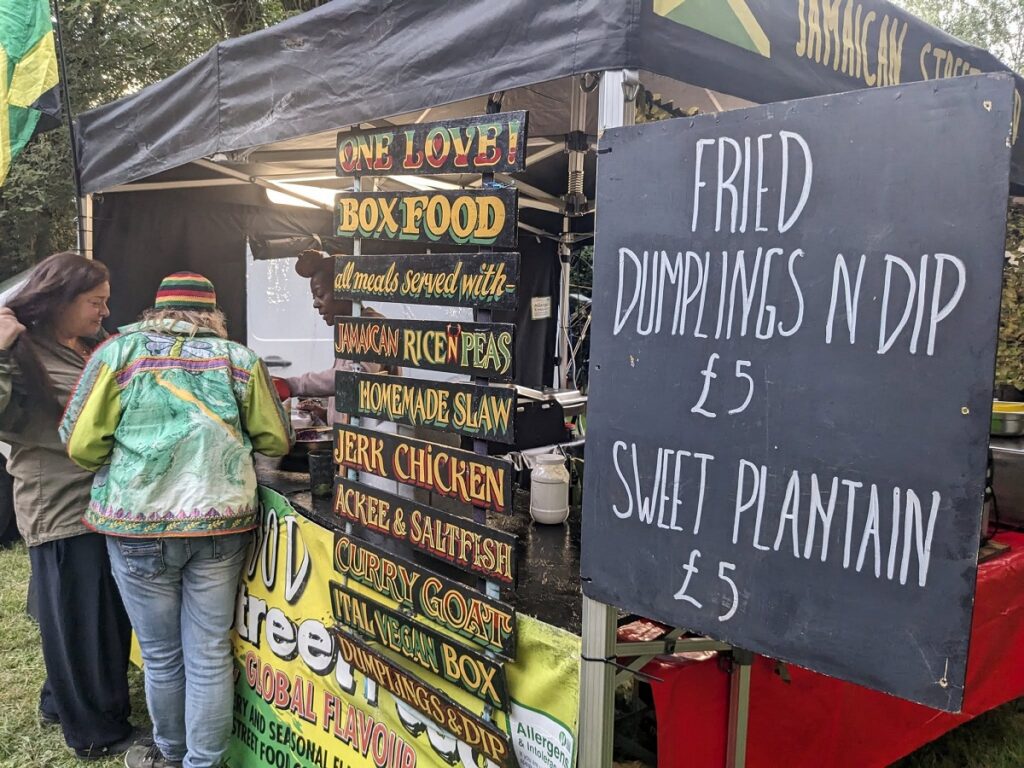
I grab a nutritious bowl of brown rice and peas, bean stew, fried plaintain and coleslaw from the Boxfood stall. Based in Northampton, proprietor Shereen Ingram supports the “neglected and vulnerable Windrush generation” in projects at home. Everyone I spoke to at this event seemed to be involved in community action, wherever they came from.
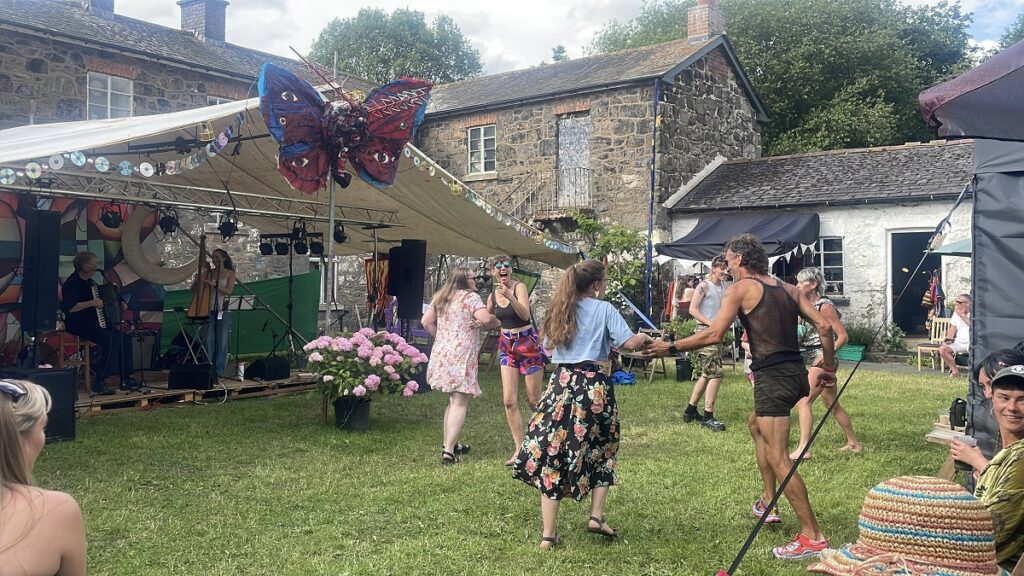
Cass Meurig, meanwhile, encourages us to “dance a Presbyterian hornpipe around the hydrangea !” The faith folksinger, who also plays with Fernhill and Pigyn Clust, uses Welsh hymns and liturgies as the springboard for her work, and is maestro of the crwth, a bowed lyre at home in ancient music. This particular hornpipe is based on a hymn about Jonah, and the banjo accompaniment makes it impossible not to twirl to the two stringed instruments.
Shadows were growing longer on our last day, and it was time for a final wander round our perfect village before it disappeared. Joanne Cotgreave, here trading with Wishing Tree, had lovely things to say about the festival, and pertinent points about border life.
“We first came here about 18 years ago – then pregnant, then with a baby – and just loved the surroundings and the old-school vibe. Then the festival disappeared for a few years. We were so excited when we heard there would be a Workhouse Party! I started selling my tie-dye three years ago when my partner and myself got made redundant – I’d always done it for friends and family – and it’s my first year trading here. The crew are kind and supportive – I have ADHD and autism, and they’ve been really great about my additional needs. I can sometimes have a lot of questions!”
Joanne lives just over the border in Chester, and it turns out there’s plenty of lore in that. “I was born in Wrexham, my mum’s home town, and I live in Chester, which was my dad’s place of birth. When the two councils were deciding which of them should offer my family a house, Chester won! I’m very aware of my dual heritage. Chester’s an unusual city, because it’s surrounded on three sides by Wales. Its Welsh name is Caer, and Chester also means ‘castle town’. The town hall clock only has three faces: the western side, which faces Wales directly, is bare. People have created a myth that still persists that Chester didn’t want to give Wales the time of day… but what about the north and south faces?
“What is true, however, is that the River Dee is named after a goddess. The English community believe it’s named after Deva Victrix, a Roman goddess of war and victory – but the Welsh secretly know it’s named after Aerfyn, a goddess of peace and fertility…”
The Easy Peelers are wrapping things up at the Courtyard with a final, lovable dose of ska and reggae. “We’re from Montgomery. It’s quite posh… so this is a rap about not being able to rap cos we’re from Montgomery!” The humour and good nature spill out of The Easy Peelers’ self-penned songs; they also throw in a cheeky, skankin’ accordion over Boyfriend, by The Undercover Hippy, and get us sweaty again with Madness standard Baggy Trousers.
Then, unbelievably, it’s time to say farewells. Before leaving, I had to thank Jim and Matt of A&E Ambulance Service, who’d helped me at a critical time when my knee joints swelled up. They’d come a long way to be here, after all. Jim, who founded the service, says, “We’re a private medical company and we specialise in providing free hospital and emergency medicines to small, independent festivals. We cover clubs too – our ethos is that no-one should suffer for having fun!
“Our friends on the security crew originally told us about Workhouse, and we come every year. We’ve slotted right in and become part of the Workhouse family.”
Matt adds, “We get to travel around the country, seeing things not everybody sees, meeting lovely people, and enjoying the atmosphere too. It’s a very happy working environment – I’ve come to Wales several times already this year. Small, community-based festivals have a special quality, and we do as many here as we can – independent events almost don’t exist anymore in Kent, where we come from. In fact, they hardly exist outside Wales.”
“Workhouse Party is a fantastic example of how human society could be, if we all loved one another and looked after each other a little bit more,” Jim says. “What a fantastic proof of concept this event is – people of all ages, all walks of life, with all kinds of outlooks and subcultures, just getting along as one. You can’t say more, can you really?”
Workhouse Party, The Workhouse, Llanfyllin, Fri 19-Sun 21 June
words JULIA DELI

