
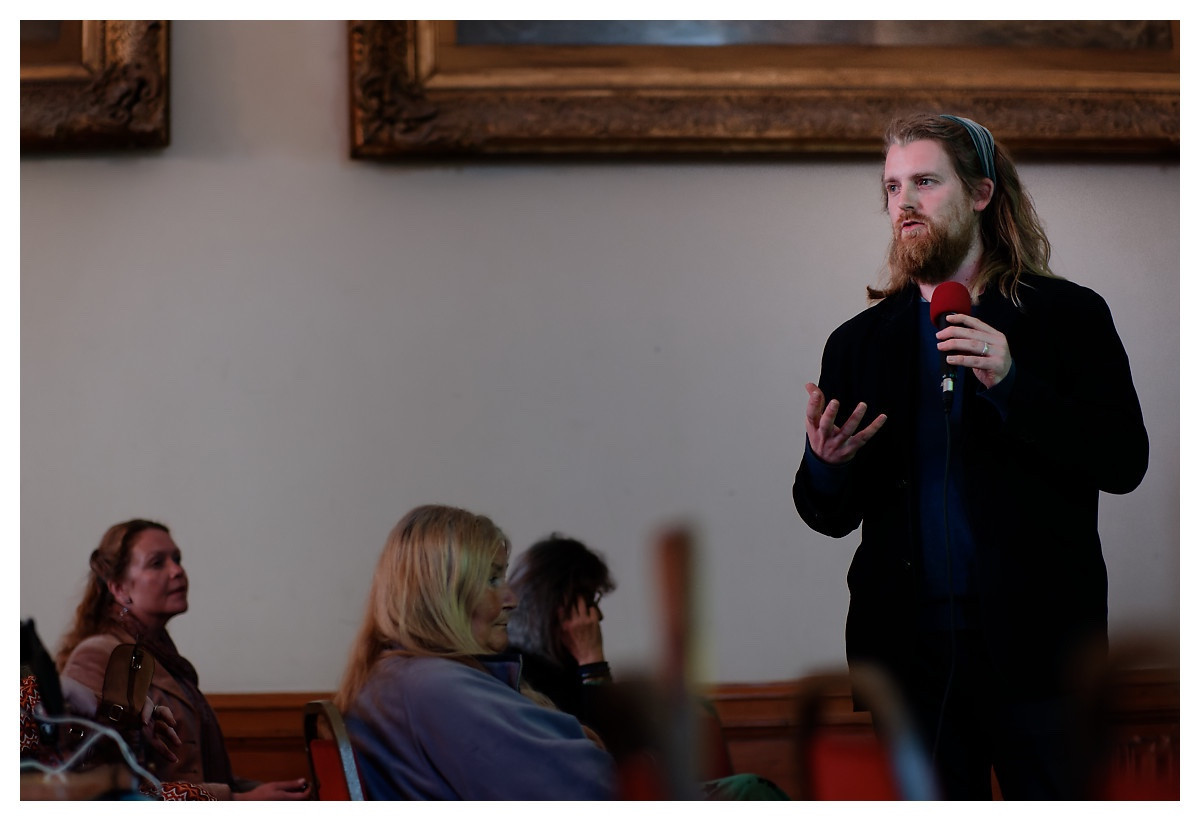
The fourth and final part of Julia Deli’s megafeature on her weekend at the Workhouse Party in Llanfyllin last month concerns a talk by Jack Hunter – not only a member of psychedelic rockers (and Workhouse faves) Mascot Moth, but a widely published anthropologist with some considerable insight into the fringes of human experience.
Intrigued by the title of Dr Jack Hunter’s talk – ‘Ecology, Spirituality and Extraordinary Experience’ – we learn that Mascot Moth’s keys and bass player is also a lecturer in Anthropology at Trinity Saint David in Carmarthen. His PhD was in Contemporary Trance and Physical Mediumship, which saw him working for 10 years with spiritualists in Bristol, concluding that “ecology and spirituality are entangled with each other.”
Lampeter University’s Alister Hardy archive, says Hunter, contains over 6,000 accounts of experiences including contact with UFOs and fairies. Both a member of the Parapsychology Foundation and a student of permaculture, his book Greening The Paranormal is an anthology, looking at the intersection of green sciences and parapsychology. Hunter quotes psychologist John Mack, who interviewed people who felt they were abductees and found many claimed “a renewed sense of connection to the natural world … the alien abduction phenomenon is occurring in the context of an ecological crisis.”
Hunter’s view is that humans have always been ecologists, and that ancient and modern nomads have an “intuitive ecology” and a knowledge of non-human entities. Science has become somewhat polarised around ecological views, he adds. Wholeism sees things from a symbiotic perspective (“forests operate as a single, living system”) while Reductionism sees things in terms of ‘survival of the fittest’. American evolutionary biologist Lynn Margulis says “the goal of life is global homeostasis”; counterpart Richard Dawkins’ belief is that life is made of “small, self-interested components, contributing nothing to the general welfare.” As if to counteract the divide, traditional ecological knowledge or TEK, acquired “over thousands of years of direct human contact with the environment”, is now in resurgence as an important concept.
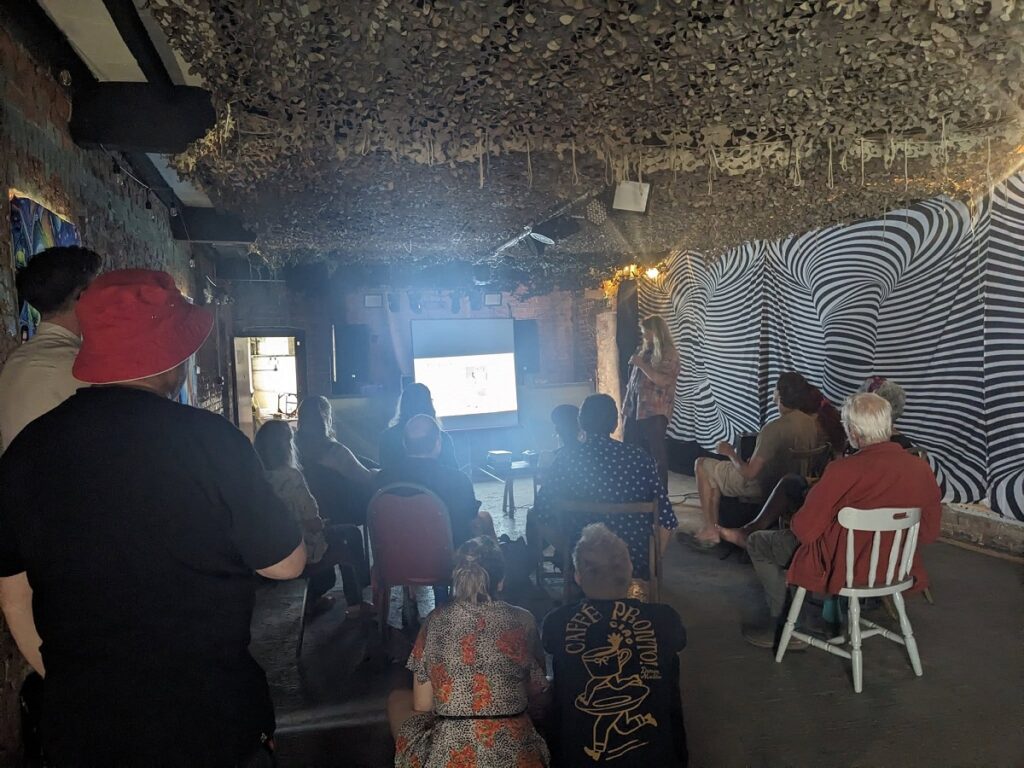
Some people claim to have had a “wild-animal-triggered peak experience” which has made them view the world differently. Aldo Leopold, founding father of environmentalism in America, had his when he had to cull wolves in his wildlife ranger job. Looking into the wolf’s eyes and wondering about the ecological sense of a cull, he recalled, “I saw that neither the wolf nor the mountain agreed with the view.”
Another book by Hunter, The Folklore Of The Tanat Valley, records stories of the fairies, giants, ghosts and UFOs that prowl the locale. Hunter’s studies led him to believe that people’s fear of the paranormal – “like the fear in the face of cosmic immensity” – may lie at the root of our need to control nature. Citing cases from UFOlogist Jenny Randles, he goes on: “We have most of these experiences in the liminal area – a grove, the wilderness, the twilight. I had an amazing experience myself, meditating with a friend in a glade. We hadn’t been sitting there long, when we had a very simple exchange. I said ‘The little blue lights have come in…’ and he said, ‘Yes, I can see them!’”
words JULIA DELI

