
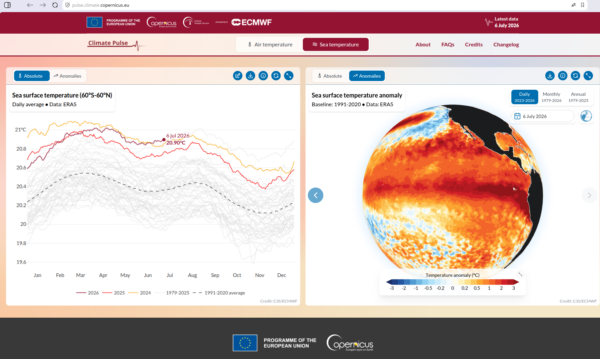
There is a new El Niño out there and it was officially declared already on June 11 by NOAA. This is both unusually early in the year and very soon since the last El Niño in 2023-24. Another remarkable thing is the seasonal forecasts, which for a couple of months have indicated that it may well be at strengths by the end of the year that we have not seen before. All these three aspects combined seem to make this El Niño different to the previous ones.
One question is whether such El Niño events, which is a phase of the El Niño Southern Oscillation (ENSO) phenomenon, is changing because of global warming.
ENSO is a natural phenomenon, but so is also the greenhouse effect. We know that exploitation of fossil resources releases greenhouse gases, such as CO2 and methane, which strengthen the greenhouse effect. This is well-established knowledge.
The first time I was confronted with the question whether global warming also may affect ENSO was back in the 1990s, when I did my D.Phil. on mechanisms responsible for ENSO dynamics.
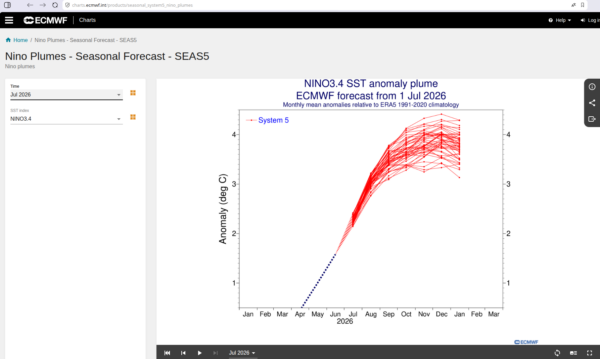
It was also the time seasonal forecasting was established at the European Centre for Medium Range Forecasting (ECMWF), and it was very much focused on ENSO. Since then, the seasonal forecasts for ENSO have made impressive progress and are now quite accurate (see the graphic above).
One indicator central for ENSO is NINO3.4 which provides a measure of how much the average sea surface temperature (SST) over the region 5°S-5°N/120°W-170°W deviates from normal conditions. The latest seasonal forecasts for NINO3.4 are shown in the graphics above.
Jacob Bjerknes was a pioneer on ENSO and the first to realise that El Niño events were coupled with changes in the atmosphere, the Southern Oscillation. Since ENSO indeed involves a coupling between the ocean and the atmosphere, there are several ways that global warming plausibly may affect how ENSO behaves.
The mechanisms that drive the ENSO dynamics include cloud formation, how winds respond to temperature changes, and how Rossby and Kelvin waves propagate in the ocean. In my D.Phil thesis from 1997, I found that the propagation Kelvin waves is affected by changes in the temperature structure. There have been many studies since then, and different global climate model studies (GCMs) have pointed in different directions.
One problem is that the GCMs may not have had detailed descriptions of small-scale parts of the system with sufficiency accuracy to give a robust result, and a quote from the Intergovernmental Panel on Climate Change, assessment report 6 by working group 1 (IPCC AR6 WG1) sums it up:
CMIP6 models are able to reproduce most aspects of the spatial structure and variance of the El Niño–Southern Oscillation (ENSO) and Indian Ocean Basin and Dipole modes of variability (medium confidence). However, despite a slight improvement in CMIP6, some underlying processes are still poorly represented.
In this case, CMIP6 refers to the World Climate Research Programme’s (WCRP) Coupled Model Intercomparison Project phase 6. While the IPCC AR6 WG1 concludes that
There is no consensus from models for a systematic change in amplitude of ENSO sea surface temperature (SST) variability over the 21st century in any of the SSP scenarios assessed,
I still think that this question is not resolved, since there are also studies suggesting that the models indicate that a global warming may result in stronger El Nino events, e.g. Cai et al., (2014) and Fredriksen et al., (2020).
References
W. Cai, S. Borlace, M. Lengaigne, P. van Rensch, M. Collins, G. Vecchi, A. Timmermann, A. Santoso, M.J. McPhaden, L. Wu, M.H. England, G. Wang, E. Guilyardi, and F. Jin, “Increasing frequency of extreme El Niño events due to greenhouse warming”, Nature Climate Change, vol. 4, pp. 111-116, 2014. http://dx.doi.org/10.1038/nclimate2100
H. Fredriksen, J. Berner, A.C. Subramanian, and A. Capotondi, “How Does El Niño–Southern Oscillation Change Under Global Warming—A First Look at CMIP6”, Geophysical Research Letters, vol. 47, 2020. http://dx.doi.org/10.1029/2020GL090640

