
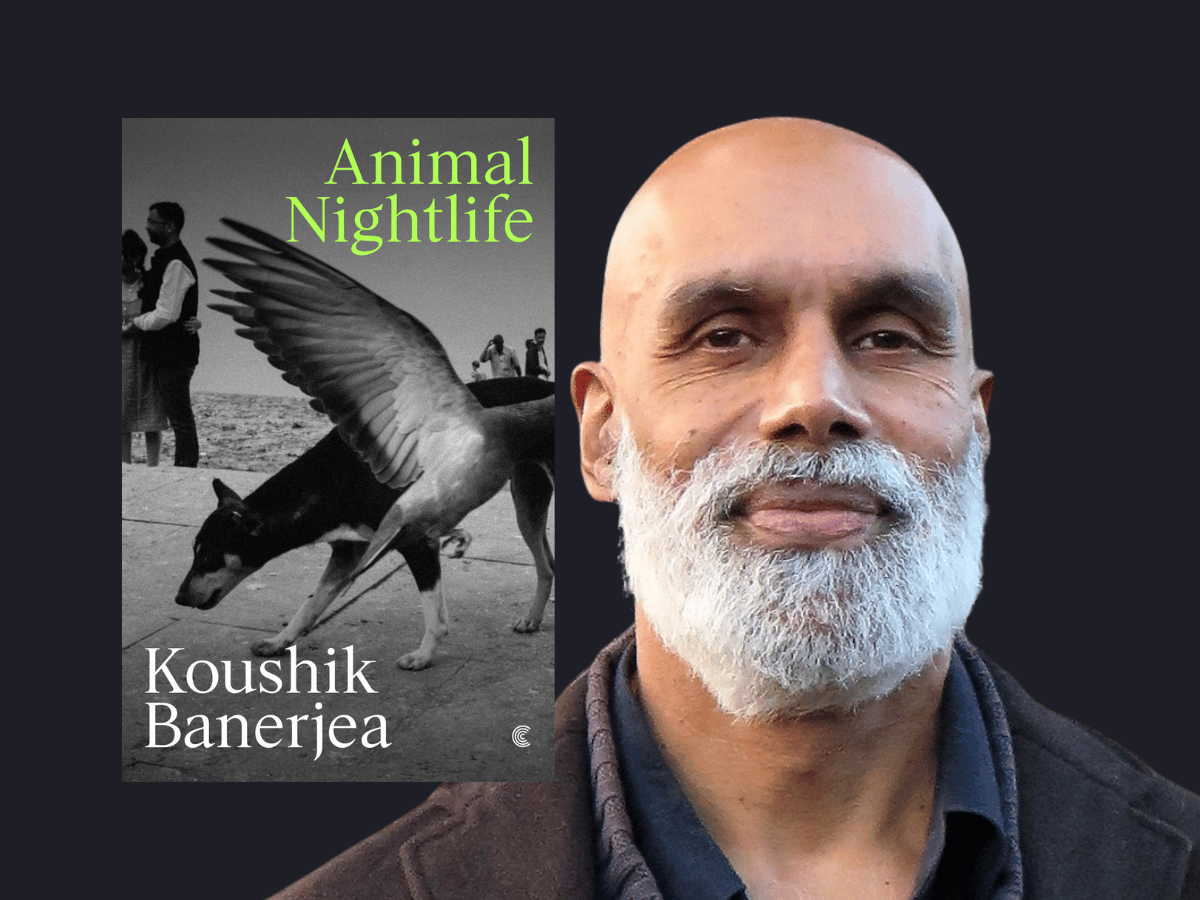
Koushik Banerjea started late as a novelist, already in his early fifties when debuting with Another Kind Of Concrete in 2020, though the London native has a creditable writing CV which predates that. Perhaps more significant, as regards the exhilarating visions and sociopolitical acuity of his third book Animal Nightlife, is his decades lived in various sharp ends and deep pockets of British culture. Swathes of which are digested and reproduced, affectionately and less so, in a head-spinning work that jumps back and forth between brash street-level realness and passages of fantastical zoomorphism.
There are three central characters – Ravi, Sean and Vikram, south Londoners (Animal Nightlife is as ‘London’ a novel as you’ll read, without making a song and dance about it) and friends since school. They’re also each ‘multiples’, blessed with the ability to take on avian forms in youth and maintained in adulthoods which have proved testing for varied reasons. Like Greek mythology, these half-human hybrid occurrences are both metaphorical and not: the scene where Ravi deposits his birdly bowels from the air onto a local racist’s head is as satisfying as it sounds.
The prose style, even at its most linear, won’t be for everyone: Banerjea, in the course of transcribing his characters’ internal dialogues, crams in so many clauses, caveats and diversions, breathing room is at a premium. It works though, partly through vividly conveying the intellects at play and partly because Animal Nightlife glows with its author’s love of language and its possibilities.
It also bursts with flavour whenever the novel’s cast – meaning Banerjea, of course – get to wax lyrical about their preferred artforms, from old Brazil World Cup teams to 1980s Nikes to music, so much music. Named in tribute to a jazz-funk band briefly popular in Banerjea’s teens, Animal Nightlife hits another plane when it’s saying its piece through a soundsystem (or home hi-fi). Some blessed happenstance has found me reading this book and Haunting The Black Air by Anthony Joseph one after the other; the latter is a poetry collection but Joseph makes his favoured sounds (some of which also crop up here) illuminate the page with the same bottomless enthusiasm.

