Here are the cheapest prices for petrol and diesel in Barry, this week.
All Right Reserved. Designed and Developed by Martyn Jones.
Here are the cheapest prices for petrol and diesel in Barry, this week.
The money-saving expert says many travellers unknowingly make the wrong choice at cash machines and checkouts – one that hands control of the exchange rate to foreign banks or retailers.
It’s a quick tap most people don’t think twice about, but over the course of a trip, it can quietly add up.
According to Lewis, the fix is straightforward – and getting it right could make a noticeable difference to how much you spend while away.
When paying or withdrawing cash abroad, you’re often asked whether you want to be charged in pounds or the local currency.
“When you go abroad and you pay on plastic and the overseas cash machine or shop asks you, do you want to pay in pounds or euros, what do you do?” he said.
“The correct answer is you should always pay in euros, or whatever the local currency is, because that means it’s your plastic that’s doing the exchange rate conversion, not the overseas shop or ATM.”
He added that even standard UK cards often still work out better overall than letting foreign machines set the rate themselves.
“Even a bog-standard UK credit or debit card… is beating most overseas ATMs or shops’ exchange rates,” he said, based on his testing.
His advice is simple: stick with the local currency every time, whether that is euros, dollars, or even dong when travelling further afield.
It might seem easier to pick pounds, but that’s where people go wrong.
Lewis says the rule is simple: always choose the local currency – whether that’s euros, dollars, or anything else.
By doing this, your own bank or card provider handles the conversion, which is typically more competitive than the rates offered by foreign ATMs or retailers.
Even standard UK debit or credit cards can outperform the exchange rates set by overseas machines, meaning that one small choice could save you money every time you use your card.
The trap is known as “dynamic currency conversion.” It’s designed to feel convenient, showing you exactly what you’ll pay in pounds — but that clarity often comes at a cost.
The exchange rate used is usually less favourable, and extra fees can be baked in without being obvious.
While a single transaction might not seem like a big deal, repeated spending – meals, transport, shopping – can quickly add up over a holiday.
A spokesperson for travel experts Ski Vertigo added: “This is a mistake many travellers make without realising. The option to pay in pounds can seem like the easier or more familiar choice, but it often comes with a less favourable exchange rate and extra charges built in.
“Those small decisions each time you make a withdrawal may seem minor, but they can quietly add up across several days of spending.”
Recommended reading:
Travel experts also warn that many people don’t check their card’s foreign usage fees before leaving the UK, which can further increase costs.
If you’re travelling abroad, the advice is straightforward: always pay in the local currency.
It might feel counterintuitive at first, but that one choice can help you avoid hidden charges and get a better deal throughout your trip.
The shop is putting on talks by celebrity foodies Matty O’Brien and Claudine Boulstridge.
Matty, well known for “fire-stoked” food at his backyard supper club in Penarth, has recently brought out his debut cook book, Boots and Bare Hands, after his cooking caught the attention of Saturday Kitchen’s Matt Tebbutt.
The chef will be joined by broadcaster and Bar44 co-founder Owen Morgan in a talk at the Paget Rooms in Penarth on Wednesday, May 6, at 7.30pm.
Matty’s story is an “unconventional” one, who two years ago would run pop-up events from a household oven and a single chip tray to now owning ten smokers in his garden.
His outdoor “Cue Fine Dining” experiences have made his Penarth cul-de-sac a must-visit destination for food lovers.
Griffin Books is also hosting a book launch for Claudine Boulstridge on Thursday, June 4.
Claudine Boulstridge will speak on June 4 (Image: Supplied)
The British-French chef, mother-of-three, and taste-tester for Yotam Ottolenghi will be sharing stories about her background as a chef and Ottolenghi taste-tester, as well as providing culinary solutions for health-conscious, time-pressed families.
Claudine’s approach is centred around elevating everyday meals into vibrant, healthy, and flavourful dishes that are suitable for children and adults.
Her book, titled Family: Simple, healthy recipes for everyone, is filled with recipes and meal ideas aimed at making family mealtimes more delicious and enjoyable.
For those who enjoy fine dining and innovative culinary experiences, Griffin Books’ events with Matty O’Brien and Claudine Boulstridge promise to be a feast for the senses.
Tickets can be purchased at the Griffin Books website or via the shop at 9-9a Windsor Road, Penarth.
The shop at 27 Harvey Street, on the corner with Quarella Road, Cadoxton, is a relative mystery. I posted on our Barry and District Museumeers page, and not many people could remember it as a shop, until our page expert found a few nice facts.
But, before we look at this research let’s look at the fabric of the building and where it fits on the old maps.
Although the building that we discuss this week at 27 Harvey Street is shown as standing, it is not marked as a shop in 1898 or 1915 on the Ordnance Survey; this is not surprising either. Most shops were not marked on maps at the turn of the 1900s.
I realised there was something special about 27 Harvey Street, as it has lots of blocked up windows and doors. The large partially blocked up window that faces Quarella Road looks like one that was used to display products, sold from a shop. The Quarella Road frontage uses primarily local yellow bricks from one of the many Cadoxton brickworks from the late 1880s. Terracotta red brick in string courses stretching around to Harvey Street is also used, and on the ground floor level plinth as well, alternating with the yellow bricks for windows and doorway detail.
The corner of Harvey Street with Quarella Road isn’t angular, but creates its own frontage. This frontage shows evidence of a former narrow door blocked up, using a different stone work than the blue Lias limestone that survives as five courses above the former doorway below. Above this is a clearly blocked window, the same stone used to block the doorway.
Here on the corner frontage, at first floor level, as with windows and the doorway on the Harvey Street front, are fine terracotta keystone bricks. In relief on the keystone is a flush of leaf detail.
Three other points: Looking at the Harvey Street frontage, this uses Lias limestone instead of yellow brick, except for windows and doorway detail. There is also a large blocked up window using a different stonework than that surrounding it. This window is very shop like. The chimneys of red and yellow brick are ornate.
Now over to what our Barry and District Museumeers said. The first sign that saw some sanity in my thinking of this building being a shop was from Sandra Campbell, who used to buy ‘toffee dabs’ from there in 1955, from an Ethel Green. However, Angela Palmer, who lived at 27 Harvey Street in the 1980s, told us it had previously been a family home for 25 years. However, more confusion?
Nino Spiteri did remember 27 Harvey Street as a shop in the 1970s. It was his friend’s parents’ shop. But the confusion is answered, as whoever ran the shop lived above.
Now some last-minute gems from the star of the show, John Anzevino of the Barry and District Museumeers. It was a shop! For in the Barry Dock News of August 7, 1891, Martel and Barker was the name of the shop at 27 Harvey Street! “The Noted Shop for Home-knitted Stockings and Real Scotch Wools. A large assortment of Gentlemen’s, Ladies’ and Children’s Socks and Stockings at a very low price.” The shop claimed in 1891 that it was ‘the sole Agents for the Sketchley Dye Works.’
But, as reported in the Barry Dock news of November 16, 1894, the shop was up for let! Known at that stage as The Central Stores. According to the Barry and District Newspaper of the day, it was “Suitable for Grocery Business. Shop complete with Fixtures and Gas Fittings. Convenient Dwelling House and Back Premises.”
On a final note this week, the Barry Dock News of November 12, 1897, tells us that a John Evans at our 27 Harvey Street shop was fined five shillings for the illegal sale of fireworks. The fireworks were exposed for sale in the window of his shop without a license. As a forensic archaeologist and film maker, I love this detail, this proves that they were blocked up shop windows after-all!
Deepest thanks for continuing to read this weekly column, and if you have any stories for us on the shop at 27 Harvey Street, email me: Karljlangford@hotmail.com
Penarth Men’s Shed will host a session titled Healthy Food Healthy Mood at Penarth Yacht Club on Wednesday, May 6, between 10am and 12pm, exploring the connection between nutrition and mental health.
Dietician Phil Addicott will lead the discussion.
The group is very pleased that Mr Addicott is able to join them to lead a chat on this essential men’s health topic.
As always, there will also be time for tea and general chat.
Details of future meetings will be shared on the group’s social media.
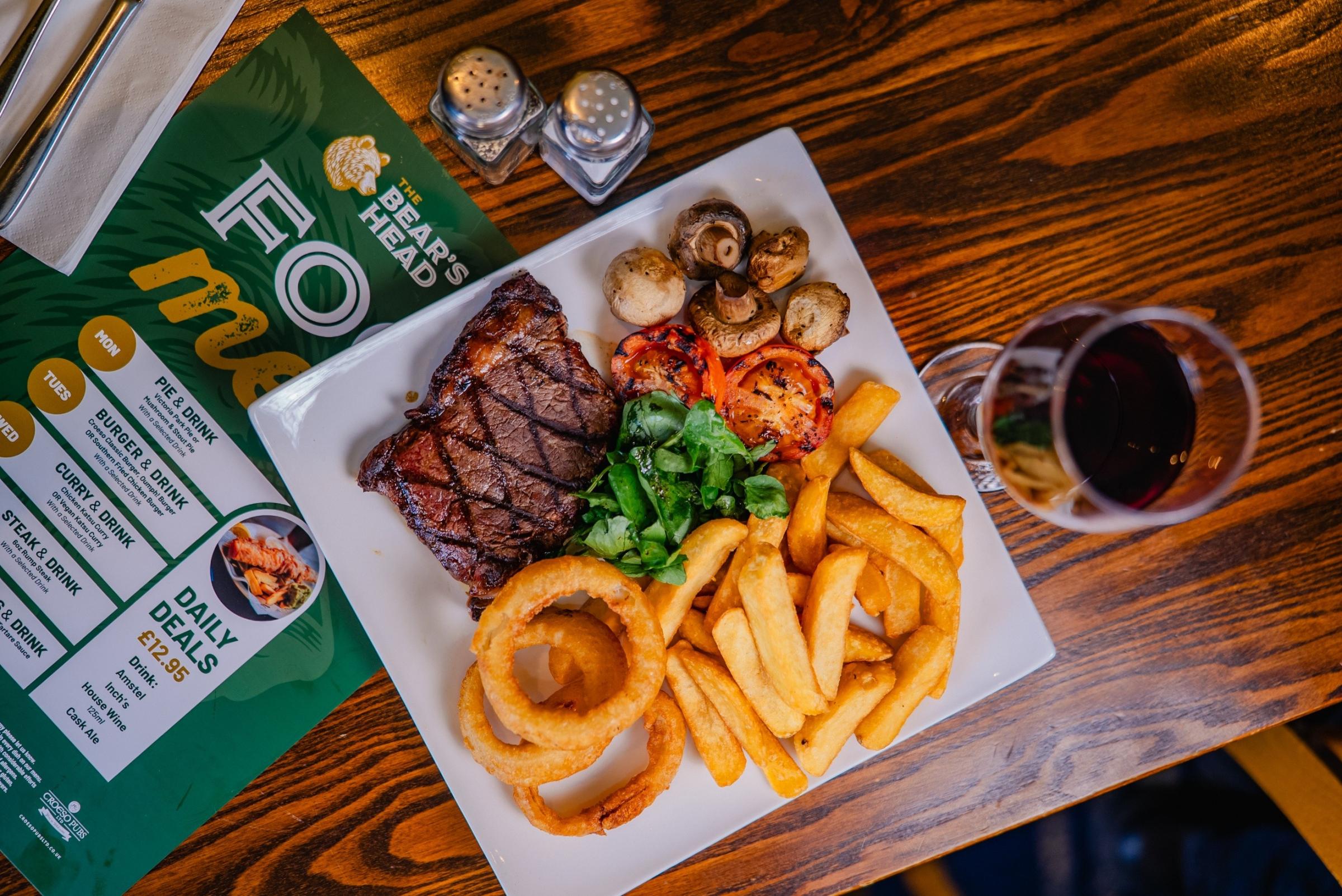
The Bear’s Head has unveiled a refreshed line‑up of dishes with a focus on high‑quality food, strong value for money and a commitment to Welsh products and suppliers, aiming to create a more locally rooted, community‑led dining experience.
Lunchtime diners can choose from four pub classics for £5, while a £9.95 meal deal offers a sandwich or baguette served with a side and a drink. Jacket potatoes are also on the menu for £6.25, with a choice of six toppings.
The Bear’s Head is also introducing five weekday offers, each pairing a meal with a drink for £12.95 to provide value and variety throughout the week.
Starters, listed under “Croeso Tasters”, showcase Welsh classics or dishes built around Welsh ingredients, including Welsh rarebit and leek on toast, Wrexham beer‑battered goujons and mozzarella fries served with Pembrokeshire Chilli Farm baconator BBQ sauce.
Sundays will feature hearty, family‑style roasts such as Welsh leg of lamb, Welsh topside of beef, turkey and Vegan Wellington, all served with the pub’s signature Croeso baked leek gratin made with Teifi smoked cheese, alongside traditional trimmings.
Executive chef Jamie Newman said the launch marked The Bear’s Head’s ambition to be “a true community hub where quality food, Welsh pride, and great value come together”.
He added: “Great food doesn’t have to be expensive, it just needs to be honest, well‑sourced, and rooted in the best of Welsh produce.”
The Bear’s Head is one of nine venues owned by Croeso Pub Ltd, which also runs Cardiff city centre spots The Philharmonic and Retro nightclub, as well as Brewhouse, Blue Bell, The Dock at Mermaid Quay, The Cricketers in Pontcanna and The Discovery in Lakeside.
Croeso area director Michael Haygarth said: “Almost two years on from taking over The Bear’s Head, we’re proud to see it evolve as part of the Croeso community pub brand.
This new menu is all about celebrating Welsh suppliers, delivering real value for our guests, and creating a place where the local community can come together and enjoy great food in a welcoming setting.”
Bookings can be made via the pub’s website at : https://thebearshead.co.uk/
Thursday will start with some patchy clouds clearing up in the early hours. Temperatures will fall to the lower single digits at this time, with a few frosty patches. High ground areas are likely to experience gusty conditions.
This will lead to a bright, dry, and sunny day with temperatures hitting a balmy 20°C.
Forecasters say high pressure will dominate the weather on Friday and throughout the weekend.
This brings dry and steady weather conditions on Friday, with no clouds to spoil the sunny skies. Temperatures will peak at 20°C, only dipping once the sun sets.
As we approach the weekend, the weather will remain warm and sunny, with light winds on Saturday. It will echo the day before, providing sun and no chance of rain, with temperatures reaching a crest to 20°C mid-afternoon.
Sunday can expect a little more cloud cover. This slight change will cause temperatures to decrease slightly. Despite this decrease in sunshine, the day will remain moderately warm and will stay cloudy into the evening and night, with temperatures reaching a high of 20°C.
The weather will shift back to sunny conditions on Monday. There will be no rain, and the day will start relatively cold, warming up to 19°C by mid-afternoon.
Tide times for the week commencing Thursday, April 23:
Thursday, April 23: 06.12 (3.27m), 12.11 (10.11m), 18.38 (3.78m)
Friday, April 24: 00.41 (9.95m), 07.21 (3.90m), 13.21 (9.36m), 19.55 (4.32m)
Saturday, April 25: 02.00 (9.40m), 08.50 (4.23m), 14.48 (9.04m), 21.31 (4.45m)
Sunday, April 26: 03.27 (9.36m), 10.24 (4.08m), 16.10 (9.27m), 22.58 (4.11m)
Monday, April 27: 04.41 (9.77m), 11.38 (3.60m), 17.15 (9.80m)
Tuesday, April 28: 00.02 (3.55m), 05.39 (10.34m), 12.32 (3.09m), 18.05 (10.37m)
Little Link ID, designed for childminders, ensures that young children can be quickly identified and safely reunited with their families if a carer becomes incapacitated while out in the community.
The platform has been awarded a £25,000 Start Up Loan from the British Business Bank, alongside business planning and support.
Launched in mid-March, Little Link ID is the brainchild of Karean Carr, a registered childminder and mother of three from Barry with 13 years of experience in the field.
Ms Carr said: “As a childminder, you’re out and about with children who aren’t your own.
“I suddenly thought: if something happened to me while driving or on a nursery run, how would anyone know who the children were with, or how to contact their parents?
“Some childminders have up to 30 children on their books.”
The platform uses digital badges, equipped with secure QR code and tap technology, that childminders can wear while working.
In an emergency, authorised responders can use the badge to access parent-verified contact details and essential safeguarding information.
Ms Carr drew on 13 years of experience in the field for the development (Image: Supplied)
Importantly, sensitive personal data remains protected through the platform’s routing technology, remaining aligned with GDPR.
Ms Carr said: “The reality is we often rely on paper notes or phone contacts that are password-protected.
“In an emergency, that’s simply not good enough.
“Little Link ID provides a work around if this situation were to ever arise, while also aligning with GDPR and protecting families’ privacy.”
Each badge links to a secure digital profile, allowing quick access to emergency contacts without exposing full personal details.
If lost, a badge can be deactivated immediately via the platform’s dashboard.
The concept is already generating interest, with more than 70 childminders joining a waitlist since its mid-March launch.
Ms Carr said: “At its heart, this is about protecting children.
“If the worst happened and a childminder was injured or unconscious, Little Link ID ensures that help can quickly identify the children and contact their families.”
The British Business Bank’s Start Up Loans team also provided help with marketing, forecasting, and identifying further funding opportunities.
Ms Carr believes the platform could transform safeguarding for thousands of solo childcare professionals.
Little Link ID builds on existing emergency procedures by digitising and securing information, making it more accessible and reliable for those caring for children outside the home.
The streets of Penarth are packed with people and no doubt all have opinions on health, education, housing, and the environment.
Yet when I spent hours in the commuter town ahead of the May 7 election I didn’t get very far.
I can tell you they didn’t know the name of their new constituency – Caerdydd Penarth – or very much about the new electoral system or if they cared very much one way or another.
Most people I attempted to talk to had no interest in the upcoming election, albeit they did know there was one.
The Senedd has long struggled with turnout. It’s never got above 50% nationally and the former constituency for the area, Cardiff South and Penarth, saw 44% of eligible voters go to the ballot box in the 2021 election.
Another area in the new constituency, the Cardiff suburb of Grangetown, was very different, with the people being more open to talk but with a more cynical attitude.
However it is still just under a month until election day and while the uber-keen may be putting out placards and circling their calendars most people are still making up their minds.
Regardless of residents’ personal interest in it the 2026 Senedd election is predicted to result in a seismic shift in Welsh politics.
This May election is starkly different from previous years as it introduces completely new constituencies and a new voting system.
Caerdydd Penarth covers parts of Cardiff, Rhondda Cynon Taf, and the Vale of Glamorgan, reaching down to Sully in the south, Pengam Green in the east, and as far as Miskin in the north, combining the two UK constituencies of Cardiff West and Cardiff South and Penarth, both of which have traditionally been Labour strongholds.
The new constituency also eats the eastern part of the former Vale of Glamorgan constituency, which has proved to be a bellwether seat in previous years.
However this most likely will change as polls project Labour looks set to face a dismal drop-off in Wales.
A quirk of these new super-constituencies is that very different areas, with very different priorities, now find themselves stuck together and electing from the same pool of candidates.
The latest YouGov poll indicates that of the six seats on offer in Caerdydd Penarth three would go to Plaid Cymru while Labour, Green, and Reform would all pick up a seat each.
Such a fragmented patch does raise questions. For example if you want to take an issue to your local MS which of the six do you pick? Does each one take an area to look after despite being elected by the whole constituency? Who handles your casework? Do all six show up to the local surgery? These questions, and others like them, remain unanswered.
Two of the most different areas put together in the new constituency are Grangetown and Penarth.
Penarth is a middle-class town sitting just below Cardiff Bay outside of the city’s boundaries. Grangetown on the other hand is a traditionally working class and multi-ethnic area of inner Cardiff.
Voters in each area had very priorities that will dictate their vote.
Matthew, a resident of Penarth who did not give his last name, told the Local Democracy Reporting Service (LDRS): “Looking out towards a Europe [and the] wider environment, these things are important to me.”
He continued: “A more kind of inclusive policy than some of the policies I might see as more negative at the moment, [that are] sort of dividing people.”
Similar sentiments were shared by another Penarth resident, Ann, who also didn’t give a last name, 71, who said: “It would be something to do with helping the population, where people are underprivileged.”
However, she criticised the increase in the number of MSs who will be elected to the Senedd in May, which is set to increase from 60 to 96.
She said: “I don’t understand why they need so many extras.”
At Penarth Pier, I spoke to Tanya, 29, who lives in Cathays in Cardiff rather than Penarth.
When the new constituencies were drawn Cathays was bisected between Caerdydd Penarth and neighbouring constituency of Caerdydd Ffynnon Taf.
Tanya landed on the Caerdydd Penarth side of the line, meaning her vote is cast with people in Grangetown and Penarth.
She shared many of the same voting areas as those in Penarth, saying: “All social aspects really, people’s mental health, social groups and stuff like that.
“[Policies] around renting and affordability for younger people [and] just everyone.”
She also mentioned the environment is an important issue she will be voting on.
People in Grangetown expressed a more critical attitude.
One resident of the area, Sally Beaman, told me: “I would say, in some ways, the health service and housing – all the obvious ones.”
She continued: “But then all the candidates all say the same things about those so I’m going a lot on track record.”
Ms Beaman went on to criticise the relationship between Welsh Government and UK Government.
She said: “[Labour] always used to complain as it was all to do with the Westminster government but now they’ve got a Labour government in Westminster.
“Nothing has changed and I think people are beginning to get fed up with the idea.
“What I am worried about is the far right getting in instead.”
She also said that, while she has got campaign leaflets through her door, she has seen no canvassers out in Grangetown yet.
Another Grangetown resident, Dunia Hatuqa, 48, said party policy regarding the war in Gaza would be the deciding factor on her vote.
She said: “It’s difficult to think about other things with that in mind but I think whoever addresses that will be able to address local issues in the same matter… [with] the attitude of fairness and inclusivity.”
In another area of Grangetown Riley Martin, 21, did not know there was an election next month.
She said: “It’s not very common to find out about politics in this sort of neighbourhood.”
Ms Martin continued: “The parties don’t really really reach out to people in this community.”
The 21-year-old said she believes the big parties should be making more of an effort to reach out in Grangetown.
“It’s definitely something that affects a lot of people and there’s a lot of young people in Grangetown so I think that if they targeted us a lot more they would definitely get a lot more votes.”
Regarding why she feels like Grangetown has been neglected during the Senedd race she said: “It’s got quite a bit of a reputation…I don’t think [the parties] think it’s a demographic that would benefit them.”
Despite the differences between the areas within the Caerdydd Penarth constituency something that all residents I spoke to shared was an inability to name the new constituency.
Something else they shared was a confusion over the new voting system that will be put in place. None could describe who it worked beyond that it was a form of proportional representation.
On a local level Cardiff Council, the authority that makes up the bulk of the population in the new seat, has been under Labour leadership for most of its history with a notable exception between 2004-2008 when it was led by a minority Liberal Democrat administration.
However in the August 2025 council by-election for the Grangetown ward Matt Youde, a member of the Green Party, was elected with 24% of the vote, which could indicate Labour’s grasp on the city loosening – a trend that can be seen across other cities in Wales and the wider UK.
The other authorities, Rhondda Cynon Taf County Borough Council and Vale of Glamorgan Council, are under Labour leadership and no overall control with a Labour plurality respectively.
However Welsh Labour is falling behind in the polls so the party’s dominance at a local level may not reflect who they will be sending to the Senedd.
According to a YouGov poll, Plaid Cymru would secure 43 seats across Wales, Reform would come in second with 30, Labour would have 12, the Greens would get 10, and the Conservatives would be left with only a single seat.
This would be a devastating loss for the Labour party as it has led the Welsh Government since devolution was introduced in 1999.

Help us create an environment in which people fifty and over can fulfill their aims and objectives in life. Fight age discrimination and help preserve and promote the independence, dignity and positive image of people fifty and over and work to ensure that they have appropriate and adequate public care provision.
All Right Reserved. Designed and Developed by Martyn Jones.